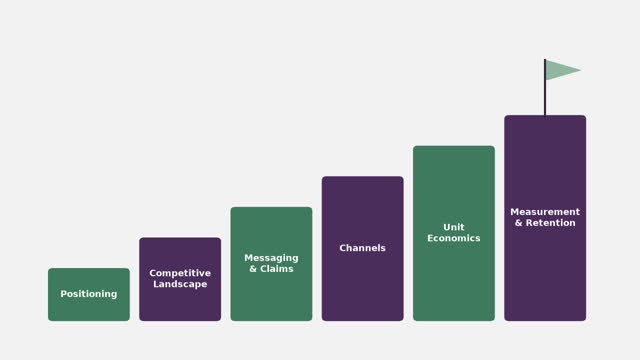
The short answer: DTC is the cheapest place to learn and often the most expensive place to grow. Retail buyers buy velocity, margin, and repeat, not your story, so the real question is the order in which you open channels so each one pays for the next.
“Start DTC, prove the brand, then go to retail.”
We hear this from founders almost every week. It sounds like discipline. Sometimes it is. A lot of the time it is a slow way to run out of cash.
What DTC is actually good at
DTC gives you data no retailer will hand you. You see who buys, what they buy first, how fast they come back, and what they say when something is wrong. You can test a price, a pack size, or a claim in a week. You keep the full margin on each order, at least on paper.
That makes DTC a great learning channel. It is a lab. It tells you whether anyone wants the product, whether they want it twice, and which message gets them to buy.
DTC-first works when a few things are true:
- The product is naturally repeat. Consumables with a real replenishment cycle can build a base that pays back over time.
- The order is big enough. A healthy basket and a real gross margin give you room to absorb shipping and ads.
- You have a reason to be online. The product needs education, customization, or a community, and a shelf cannot deliver that.
- You have an owned audience. You can reach people without paying for every click.
If most of those describe you, DTC-first is a sound start. If few do, read on.
When DTC burns cash
The problem with DTC is not that it fails. It is that it looks like it is working while the cash drains out.
Revenue is easy to buy. Profit is not. The number that matters is contribution margin per order, and most founders never build it line by line. Do it once, honestly:
- Start with net revenue after discounts.
- Subtract product cost and inbound freight.
- Subtract pick, pack, and outbound shipping. Shipping is often the line that surprises people, especially on heavy, bulky, or low-price items.
- Subtract packaging, payment fees, and platform fees.
- Subtract returns and refunds, including the product you never resell and the shipping you paid twice.
- What is left is the margin that has to pay for your customer acquisition cost.
Returns hide inside “net revenue” and customer service, and in categories with fit, shade, or scent risk they eat margin quietly. Retail absorbs some of that risk. DTC hands all of it to you.
Now compare that to what you pay to get the customer. If contribution margin on the first order does not cover CAC, you are betting on the second and third order. That can be a fine bet for a true repeat product. It is a bad bet for a product people buy once a year.
We look at it the way our founder looked at any promotion at a big CPG company. You do not judge it by the lift. You judge it by what it left in the P&L after everything was paid. DTC is the same. Growth funded by paid social is a promotion you have to run forever, and every year the auction gets a little more expensive.
And there is the trap we see most often: a brand reaches a DTC plateau, spends more to push through it, and then walks into a retail meeting on the back of a story and a follower count. That is the wrong meeting to walk into.

What retail buyers actually care about
Our founder has sat on both sides of that table, and he has bought divested brands where the numbers were all that mattered. A buyer has limited shelf and a category to run. They want to know three things.
Velocity. How fast does this sell per store, per week, compared to what is already there? Your online following tells them very little. Sell-through tells them a lot. Space is finite, and an item that turns slowly gets cut.
Margin. Does the product give the retailer the margin they need after their costs and their promotions? If your price ladder does not leave room, nothing else matters. We covered that math in Retail Pricing Math Founders Get Wrong.
Repeat. Will shoppers come back and buy it again, or is this a one-time trial that fades? Repeat is what makes a facing safe.
Notice what is missing: your brand story. Story helps you get a meeting. It does not keep you on the shelf. At Bath & Body Works the store was the whole business, and every item earned its space by moving. That standard is not unusual. It is retail. For the fuller buyer-side checklist, see Retail Readiness Strategy: 4 Things Buyers Want to See Before They Say Yes.
Retail-first and hybrid can work
If your product is an impulse buy, a low price point, or something shoppers want to pick up and see, the shelf does the selling that a paid ad cannot afford to do. If you can make regional retail work with a small number of doors and good velocity, you get real volume and real proof without paying for every customer one click at a time.
The catch is that retail has its own costs. Slotting, trade spend, markdown support, chargebacks, and long payment terms all pull on cash, which we wrote about in Trade Spend Is Not Marketing. Retail-first without working capital and a plan for those costs is just a different way to run out of money.
Hybrid is often the honest answer. Use DTC to learn and to hold price. Use a narrow slice of retail to reach the shopper who would never find you online. Watch whether the two help or hurt each other. A retailer will notice quickly if you are undercutting them on your own site, so keep pricing consistent across channels.
How to sequence channels so each one funds the next
Here is the framework we use. It is simple on purpose.
- Set the job for each channel. Write one line: DTC is for learning and repeat data, retail is for reach and volume. A channel with no job becomes a cost center.
- Build the contribution margin by channel. Take a unit from price to profit in each channel, including fulfillment, returns, fees, and trade. Do not blend them. A blended number hides which channel is paying the bills.
- Find the payback point. For DTC, how many orders does it take for contribution margin to cover CAC? If you cannot answer, do not scale spend yet. For retail, how many weeks of sell-through does it take to recover the launch cost?
- Pick the hero and prove it. Lead with one SKU. Get its velocity and repeat solid in the first channel before you expand the line. We wrote about why in Your Hero SKU Is Lying to You.
- Set a graduation trigger. Decide in advance what result earns the next channel: a repeat rate, a payback window, a contribution margin floor. Write the number down before you start. Otherwise you will move the goalposts.
- Open the next channel with cash from the last one. Use margin, not hope, to pay for launch. Start with a narrow slice, such as a single retailer or a region, so a miss is survivable. Then review each channel on its own P&L every quarter and shrink the ones that do not earn their spot.
If you want a second opinion on your own sequence, grab 15 minutes with us and bring your channel P&L.

Decision checklist: DTC-first, retail-first, or hybrid?
Run this before you commit budget to the next channel.
Is DTC-first right?
- Contribution margin on the first order is positive after shipping, fees, and returns
- CAC is covered within a payback window you can survive
- The product has a real repeat cycle
- You can reach buyers without paying for every click
- You know what result will graduate you to retail
Is retail-first right?
- The product sells on sight, on impulse, or on price
- Your price ladder leaves the retailer their margin and still leaves yours
- You can fund slotting, trade, and payment terms
- You can supply a narrow set of doors without stockouts
- You have a plan to drive velocity, not just get on the shelf
Is hybrid right?
- Pricing can stay consistent across your site and the shelf
- Each channel has a written job and its own P&L
- Inventory and fulfillment can handle both without one starving the other
Before any retail meeting
- You can state velocity, margin, and repeat in plain numbers you have verified
- You know what the launch will cost and when it pays back
Why this comes back to cash
When we look at a brand, we do not care which channel came first. We care whether the channels are paying each other forward or draining each other dry.
The founders who get this right treat channels like a relay. DTC teaches and proves. A narrow retail launch borrows that proof and adds reach. The margin from one funds the launch of the next. Nobody runs faster than the cash allows.
DTC-first is a good path when the economics support it. It is a poor one when it becomes an ad budget in disguise. The way to tell the difference is a contribution margin sheet and the honesty to read it. For the wider list of commercial errors that get brands into trouble, see The 7 Biggest Go-to-Market Mistakes CPG Founders Make.