The short answer: Distribution amplifies what is already true about a brand, so more doors multiply a velocity problem. Add doors only when same-store velocity on the same UPC is growing, past the launch spike, and the growth is not just new distribution or paid support. If it is not, say “not yet” and fix velocity where you already are.
Every emerging brand gets the call eventually. A buyer likes the item and offers more doors. It feels like the moment you have been working toward. Often it is the moment the brand starts to struggle.
We have seen this from both sides of the desk. Our founder ran mature brands at Dial, launched White Barn Candle Co. and Wallflowers at Bath & Body Works, and later bought and grew Pert Plus and Sure. The lesson held at every scale: distribution amplifies what is already true about a brand. If shoppers are not coming back, more shelves just multiply the problem.
Dr. James Richardson of Premium Growth Solutions, who writes about CPG growth for Inc., made a sharp version of this case in “Why Most New CPG Brands Fail to Reach $10M (And What the Winners Do Differently)”. His point is simple. Acceleration is not a default setting. You earn it.
Why chasing doors kills brands
Richardson notes that the brands people point to as hypergrowth stories, names like Kevin’s, Gruns, and Poppi, had experienced teams, millions in seed capital, and product design that hit the category at the right time. Most founders do not start there. For them, he argues, speed is a privilege earned by “managing a small experiment” well.
He lists what that experiment needs: working seed capital (at least $250K to $1M, in his estimate), a high-trust team, and some luck on category timing.
Here is why premature doors hurt. Every new account brings slotting, promotion commitments, inventory, and freight before it brings a dollar of sell-through. If the item does not turn, the retailer notices fast. Now you are funding a bigger footprint with weak velocity, and the cuts that follow land in more places at once. Our post on sizing your first retail rollout covers starting regional and knowing when to grow.
In his related writing, Richardson adds that founders struggle to say no to buyers offering doors too early. We agree. Saying yes feels like growth. On the P&L, it often is not.
What organic momentum is
Richardson’s test is what he calls organic momentum. In his framing, that means the brand is growing without paid marketing, and the growth is not just distribution gains.
That second part matters. Adding stores will raise total sales. It tells you nothing about whether shoppers want the product more than they did last quarter. Organic momentum asks a harder question: in the places you already are, is demand rising on its own?
The scanner math in plain English
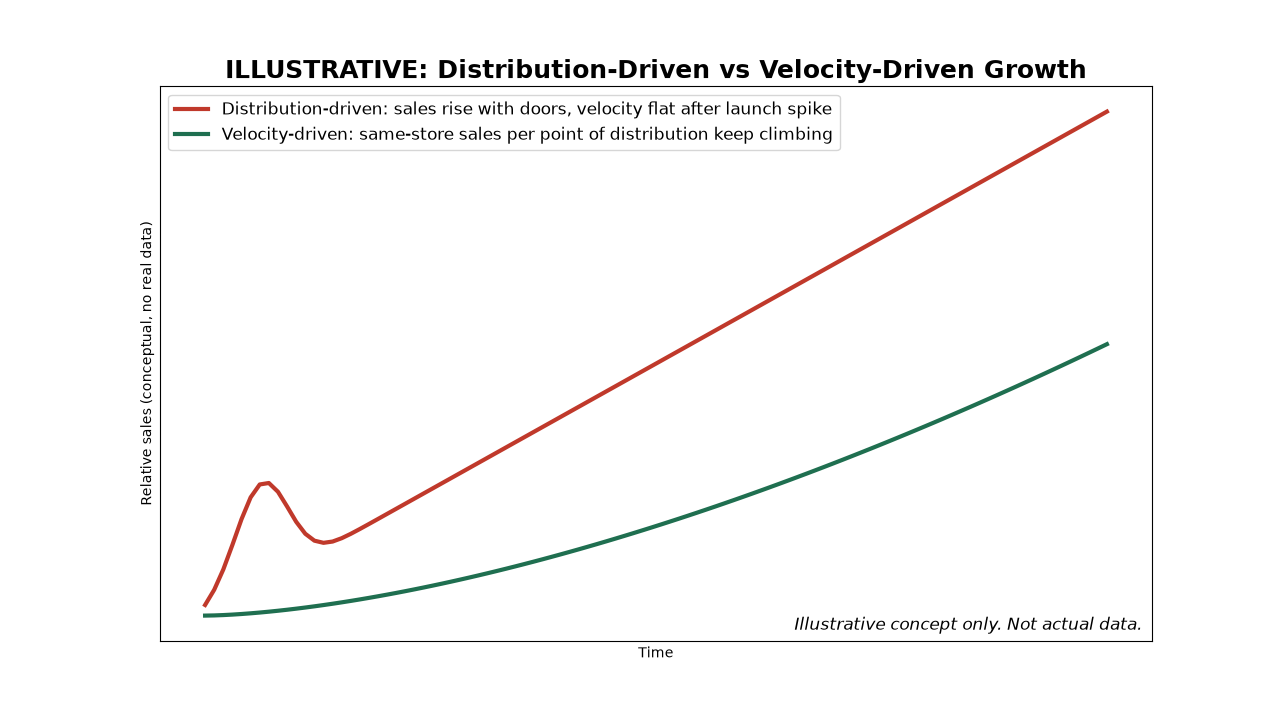
Total dollars have two parts: how many stores carry you (distribution) and how fast you sell in each one (velocity). Grow the first and sales go up even if the item is stalling. Only the second shows real pull.
Richardson points to same-store velocity growth as the retail signal. The common measures:
- $/%ACV: dollars sold per point of weighted distribution. It adjusts for how many, and how big, the stores carrying you are.
- $ per million ACV: the same idea, normalized to store volume.
Read it on a rolling quad-week basis. Single weeks are noisy. Four-week rolls smooth out promotions, holidays, and out-of-stocks, so you see the trend.
Watch the launch spike. New items often post strong early numbers from trial, fresh displays, and intro promotions. Richardson’s related writing flags these launch velocity false positives. The real number is where velocity settles after trial fades. Judge the brand on that line, not the first month. We cover what buyers watch once you are on shelf in the first 90 days on shelf.
His threshold, from his writing at Premium Growth Solutions: expand doors when velocity on the same UPC in the same accounts is growing roughly 20 to 25% annualized, sustained for about 18 months. That is a high bar. It is meant to be.
The online version: cohort repeat and nROAS
If you sell direct or on marketplaces, the signals change but the logic does not.
Repeat purchase rate by cohort. Group customers by the month they first bought. Track what share come back over the following months. If newer cohorts repeat as well as or better than older ones, the product is getting stronger. If each cohort repeats worse, you are buying customers who do not stay.
New-customer ROAS (nROAS). Richardson flags declining new-customer ROAS as a warning sign. If each dollar of ad spend brings in less first-order revenue over time, you are paying more for demand that is not building on its own. Blended ROAS can hide this because returning customers prop it up. Separate them.
When to say no to a buyer, and what to do instead
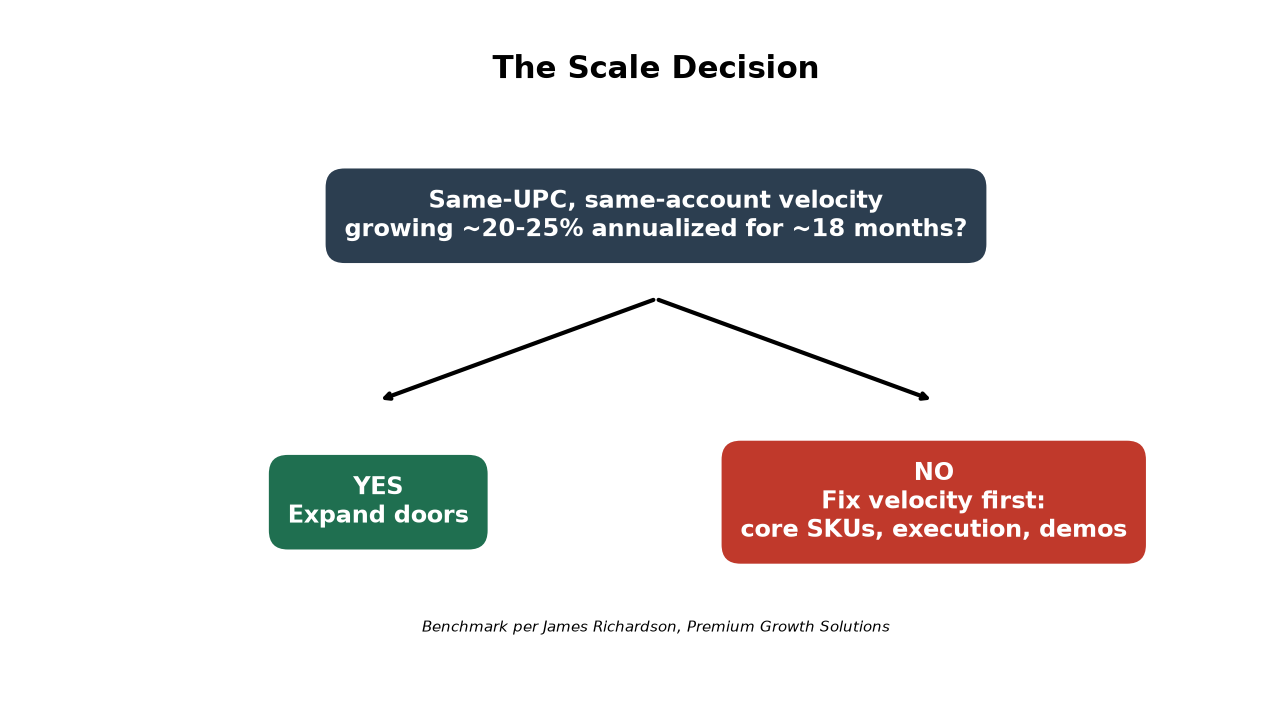
Say “not yet” when your same-store velocity is flat or falling, when you are still inside the launch window, or when you cannot fund the route-to-market cash the expansion requires. A clear “let us earn it first,” with a plan and a date, beats a yes you cannot support. Buyers remember brands that perform. Before you say yes to any account, make sure every margin still gets paid.
Then use the time. Fix velocity where you already are:
- Focus on core SKUs. Put effort behind the items that turn. Richardson lists too many UPCs in unrelated categories among the common mistakes.
- Make smart UPC moves. New items should help the core sell, such as a pack size that fits a different trip or price point, not a new category that splits your attention.
- Win in-store execution. Check shelf placement, facings, pricing, and out-of-stocks account by account. Velocity problems are often execution problems.
- Run demos and sampling. Trial in the store, where the shopper can buy, is one of the most direct levers on velocity.
- Revisit the product. Richardson warns against believing the original product is perfect. Listen to repeat buyers and to the people who did not come back.
- Engage fans early. Loyal customers are your best source of feedback and word of mouth. Richardson calls out skipping this as a mistake.
The rest of his list is about money. Do not assume venture capital will show up. Plan the cash it takes to get to market in each new account before you say yes.
Readiness checklist
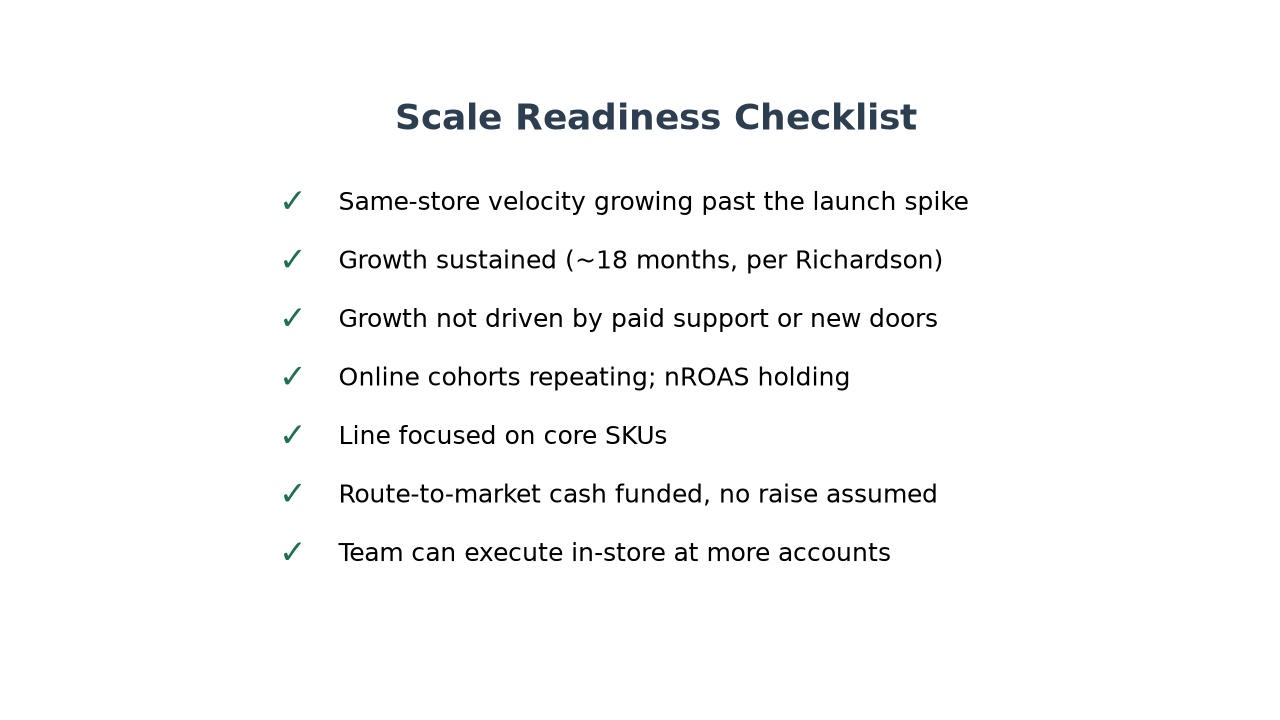
Before you add doors, you should be able to say yes to each of these:
- Same-UPC, same-account velocity is growing on a rolling quad-week basis, past the launch spike.
- That growth has held for a sustained period. Richardson’s benchmark is roughly 20 to 25% annualized for about 18 months.
- Growth is coming without heavy paid support and is not just new distribution.
- Online, newer cohorts repeat at least as well as older ones, and nROAS is holding.
- Your line is focused on core SKUs that earn their space.
- You have funded the route-to-market cash for the expansion, without counting on a raise.
- Your team can execute in-store in more accounts without letting current ones slip.
If you cannot check all seven, the answer is not “never.” It is “not yet,” with a plan to get there.
Earn it, then scale it
Our founder has helped scale brands fast, including the launches of White Barn Candle Co. and Wallflowers at Bath & Body Works. The formula is the order of operations: prove pull, then add reach. The market pressures behind that order are in our post on six CPG shifts making go-to-market harder.
If a buyer is offering doors and you are not sure your numbers support it, talk with us. Vantage Business Consulting helps emerging brands read their velocity, fix what is holding it back, and plan expansion they can fund. Start a conversation with Vantage Business Consulting.
Sources: James Richardson, “Why Most New CPG Brands Fail to Reach $10M (And What the Winners Do Differently)”, Inc. Additional points from Richardson’s writing at Premium Growth Solutions.