The short answer: The Launch Readiness Scorecard is a free, three minute self assessment for consumer brands. Twelve questions across six areas give you a score out of 24, a result band, your three biggest gaps, and a written report. Use it to find the weakest part of your plan before you spend or meet a buyer.
Most launches that stall do not fail on the product. They fail on something upstream: a customer nobody pinned down, a claim nobody reviewed, a margin nobody calculated by channel. Those gaps are cheap to fix before you spend and expensive to fix after.
That is why we built the Launch Readiness Scorecard. It is a free tool on our site, and it takes about three minutes.
What the scorecard is, and who it is for
The scorecard is twelve multiple choice questions. It is built for supplement, CPG, beverage, food, and home fragrance brands that are planning a launch, a relaunch, or a rebrand. It works whether you are prelaunch, launched in the last twelve months, or established and expanding.
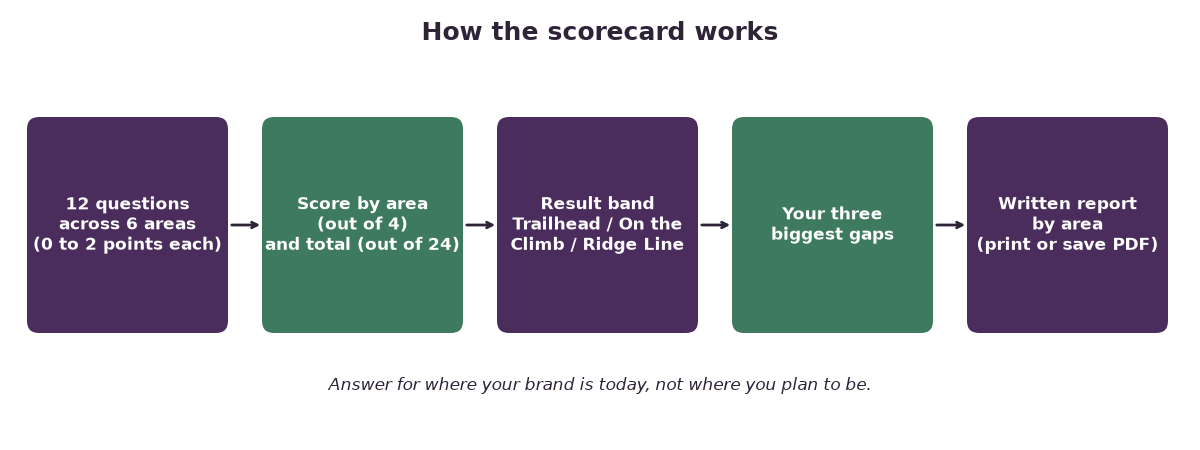
You answer for where your brand is today, not where you plan to be. That one instruction matters more than any question on the list. A generous answer only hides the gap you came to find.
At the end, you share a few details: brand stage, primary sales channel, monthly revenue range, timing of your next launch, your first name, brand name, and work email. Your results open right away. By continuing, you agree to receive occasional emails from Vantage Business Consulting, and you can unsubscribe anytime.
What it scores, and why those six areas
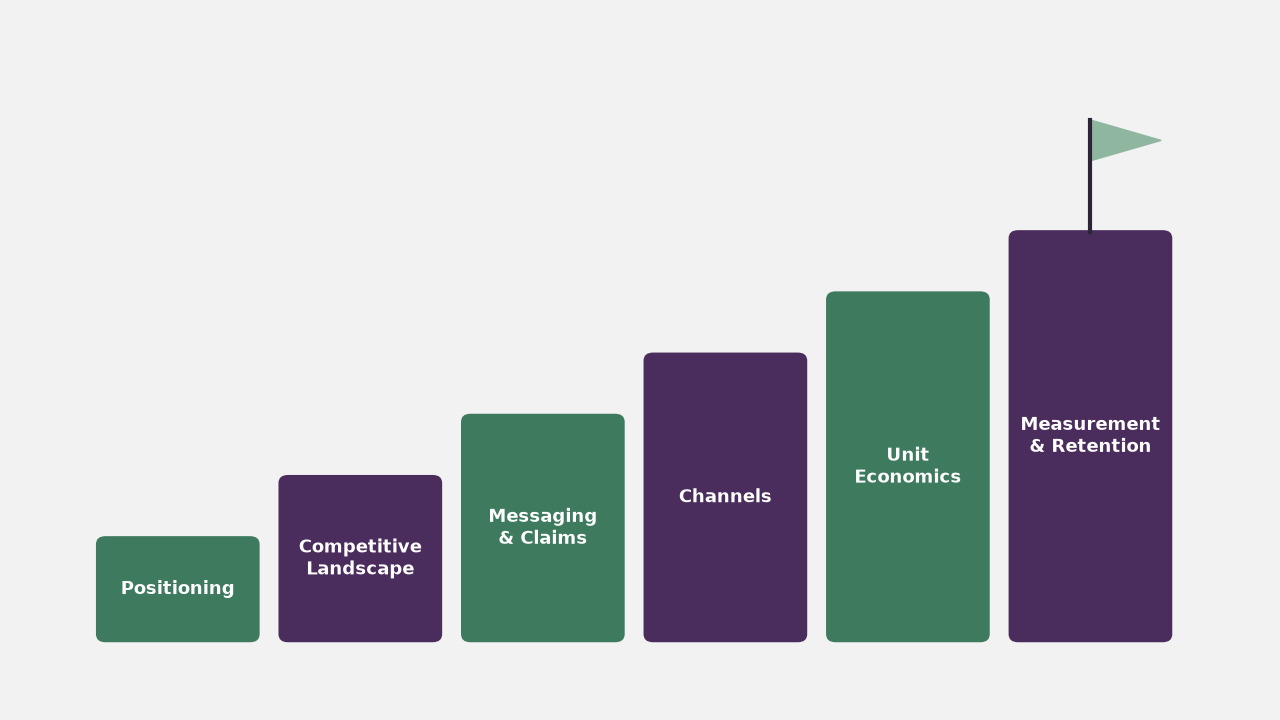
The scorecard asks two questions in each of six areas, from positioning to retention, and each answer is worth zero, one, or two points. That gives each area a score out of 4 and the whole scorecard a score out of 24.
- Positioning. Can you describe your target customer in one sentence, including what they have already tried? Can you say why someone would pick you over your top competitor? If you cannot name who you are for, every marketing dollar works twice as hard.
- Competitive Landscape. How well do you know your top five competitors’ pricing, claims, and reviews, and have you studied their negative reviews? Those reviews tell you what customers wish someone would fix.
- Messaging & Claims. Has your claims language been reviewed for structure/function compliance, and do your label, listing, and ads tell the same story? In supplements, the wrong claim can get a listing pulled.
- Channels. How many channels are you launching on, and do you have a dated 90 day calendar? Winning one channel first builds the proof to expand. We cover the order of operations in channel sequencing.
- Unit Economics. Do you know your gross margin after product cost, shipping, and fees, and how much you can afford to acquire a customer? Without that, you cannot tell profitable growth from expensive growth.
- Measurement & Retention. Which numbers do you review every week, and do you have a plan to drive repeat purchases? Consumer brands live on the second and third order.
We picked these six because they are the foundation a launch sits on. Packaging, creative, and ad spend all depend on them.
How to read your score
Your results page shows your total, a trail graphic of where you sit, a chart by area, your three biggest gaps, and a written report. Scores fall into three bands: Trailhead from 0 to 8, On the Climb from 9 to 16, and Ridge Line from 17 to 24.
- Trailhead (0 to 8). Major gaps in the foundation. Launching or scaling now risks spending money before the strategy can support it. These are also the most fixable problems in the business, so fix them before you buy inventory or media.
- On the Climb (9 to 16). A solid start with a few gaps that will slow you down. Close them before your next push, starting with the lowest area.
- Ridge Line (17 to 24). A strong foundation. Your focus shifts from fixing the base to scaling what already works. The report lists areas to keep an eye on instead of gaps.
Inside the written report, each area is labeled Needs work (0 or 1), Developing (2 or 3), or Strong (4). Each one includes why the area matters, a recommendation for your level, and a line on what strong looks like. You can print it or save it as a PDF and share it with your team.
Using it before a buyer meeting
Say you have a meeting with a regional grocery buyer in three weeks. Here is how we would use the scorecard.
- Take it honestly, today. Answer for the brand as it is now, not the deck you plan to show.
- Find your lowest area. If Unit Economics comes back at 1 of 4, that is your first job. A buyer will ask what your margin is at their shelf price, and a guess will show. Our launch forecast guide helps you build numbers that hold up.
- Use the target line. Before a buyer meeting, work on your lowest scoring area first, using the “what strong looks like” line in your report as the target. For Unit Economics, that is gross margin by channel and a target customer acquisition cost tied to repeat rate.
- Check the rest against the buyer’s list. Pair your report with our retail readiness checklist for what a buyer asks for before the first PO.
- Retake it. Once the work is done, retake the scorecard and see if the area moved.
What it does not do
The scorecard is a self assessment for planning, not legal or regulatory advice, and it does not check your claims or your numbers for you. It scores what you tell it. If you mark your claims as reviewed by a regulatory expert, it takes your word.
It also does not replace a forecast, a P&L, or a buyer conversation. It is a fast way to see where to look first.
Where this leaves you
Three minutes is a small price to see the gap before a buyer or a bad quarter shows it to you. Our founder has spent decades launching consumer brands, and the same six areas decide most outcomes. At Vantage Business Consulting, this is the foundation we help founders build.
Next step: Take the Launch Readiness Scorecard and see which of your six areas needs work first.