The short answer: Most emerging brands set price in the wrong direction, starting from cost. Start at the shelf, work backward through retailer, distributor, broker, trade, and freight, and see what is left for you, so a weak answer shows up on a spreadsheet instead of in your bank account.
Most emerging brands set their price in the wrong direction. They start with what the product costs to make, add a markup that feels fair, and hope the shelf price lands somewhere reasonable. Then a distributor asks for 25 percent, the retailer wants 40, the broker wants 5, and the first promo calendar eats whatever was left.
At Vantage Business Consulting, we build pricing the other way. Start at the shelf, work backward, and see what is actually left for you. If the answer is not enough, you find out on a spreadsheet instead of in your bank account.
Start With the Shelf, Not the Factory
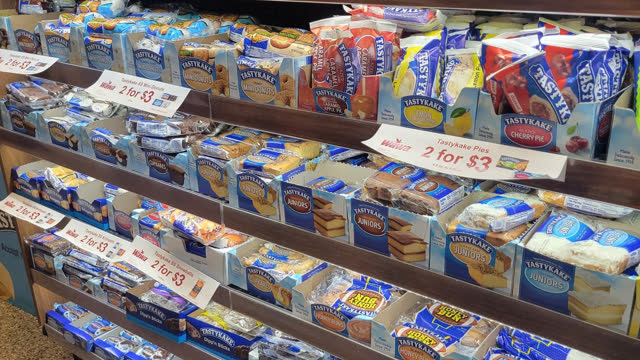
The shopper decides your price ceiling, not your cost sheet. Walk the aisle where you want to live. Write down the price, size, and price per ounce (or per serving, per count, per burn hour) of the five to eight products you will sit next to.
That competitive set gives you a realistic target retail price. Price points matter too. Shoppers notice $9.99 versus $10.49 far more than $9.49 versus $9.79. Pick a point that fits the set and tells the story you want: value, mainstream, or premium.
Only once you have that number do you start subtracting.

The Waterfall: Who Gets Paid, in Order
Every unit sold at retail pays a chain of partners before a dollar reaches you. In order, working back from the shelf:
- Retailer margin. Calculated on the retailer’s sell price, not on their cost. Conventional grocery often runs 30 to 40 percent, specialty and natural can run 35 to 45, and some channels go higher.
- Distributor margin. Also calculated on their sell price to the retailer. Commonly 20 to 30 percent for natural and specialty distribution.
- Broker or rep commission. Usually a percentage of your invoice price, often 3 to 5 percent. We cover how to pick and pay them in our post on choosing reps and brokers.
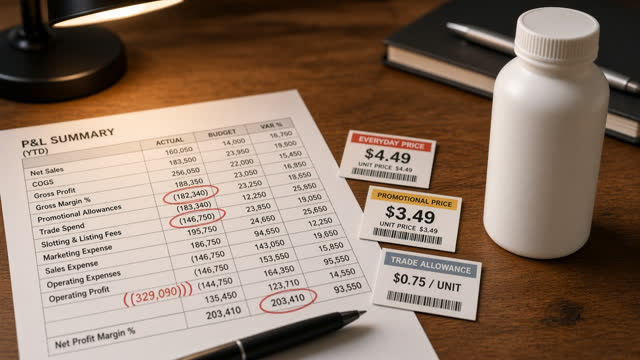
- Trade spend and promotion. Temporary price reductions, scan downs, demos, ads, and free fills. Budget it as a percentage of gross sales. New brands often need 15 to 25 percent in year one.
- Freight. Getting product to the distributor’s warehouse, plus any fuel or minimum order surcharges.
These are typical planning ranges; confirm the real numbers with each account.
What is left is your net revenue per unit. Subtract COGS, and you have brand gross margin. That number funds marketing, people, and profit.

An Illustrative Example With Round Numbers
This is an illustrative example only. The figures are round numbers chosen to show the math, not benchmarks for your category or results from any client.
Say the competitive set supports a $10.00 shelf price.
- Shelf price: $10.00
- Retailer margin at 40 percent: retailer pays $6.00
- Distributor margin at 25 percent: distributor pays you $4.50 (because $4.50 is 75 percent of $6.00)
- Broker commission at 5 percent of $4.50: $0.23
- Trade spend at 15 percent of $4.50: $0.68
- Freight per unit: $0.30
- Net revenue to the brand: $3.29
- COGS: $1.80
- Brand gross margin: $1.49 per unit, about 45 percent of net revenue
Look at what happened. A $10.00 product left you $3.29 to work with. If your COGS were $2.50 instead of $1.80, your margin would drop to about 24 percent, and the business would struggle to fund anything beyond survival.

The Costs That Don’t Show Up in the Waterfall
Some real costs do not fit neatly into per unit math, so we keep them out of the waterfall and plan for them separately.
Payment terms. Many distributors and retailers pay on net 60 or net 90 terms, meaning you wait two to three months for cash after you ship. That money is tied up while you pay for the next production run. Some partners also ask for an early pay discount, written like “2/10 net 30”: they take 2 percent off the invoice if they pay within 10 days, otherwise the full amount is due in 30.
EDI fees. Larger accounts require electronic data interchange for orders and invoices, usually through a third party provider that charges setup and per transaction fees.
Retailer data and portal fees. Some retailers charge for sales data or access to their supplier portal.
Deductions and chargebacks. Expect money taken off your payments for compliance fines, shortages, and promo deductions, sometimes months later.
Do not force these into the shelf math. Budget a reserve of a few points of margin, and track every fee and deduction by account so you know which ones are worth it.
Not sure your waterfall holds up? Grab 15 minutes with us →
Common Mistakes We See
Pricing off COGS plus a markup. Doubling your cost tells you nothing about whether shoppers will pay the resulting shelf price or whether partners can earn their margin along the way. Cost plus pricing usually lands either too high for the set or too low to fund trade.
Forgetting promo depth. If your category runs 20 to 30 percent off promotions every few months, that discount comes out of your pocket, not the retailer’s. Model the promo price through the same waterfall and confirm you still make money on a promoted unit.
Ignoring slotting and free fills. Slotting fees and free first orders do not show up in the per unit math, but they hit cash hard at launch. Treat them as a launch investment and size them alongside your rollout plan, as we lay out in our post on sizing your first retail rollout.
Believing the keystone myth. Keystone means the retailer doubles their cost. It is a useful shorthand in some gift and specialty channels, but it is not a rule. Multi-tier distribution, broker fees, and trade change the math. Use the actual margin each partner quotes.
Confusing margin with markup. A 40 percent margin is not a 40 percent markup. Retailers and distributors quote margin on their sell price. Mix the two up and you will underprice by a meaningful amount.
Pricing outside the set. Being 30 percent above the category leader needs a clear reason the shopper can see in two seconds. If you cannot name it, your velocity will tell you.
When the Math Does Not Work
If the waterfall leaves too little margin, you have four levers, roughly in order of ease:
- Change pack size or count so the price per unit of use fits the set while the shelf price supports the chain.
- Lower COGS through packaging changes, run sizes, or ingredient sourcing.
- Change channel mix. Direct to retailer, or direct to consumer alongside retail, can remove a tier for some accounts.
- Raise the price only if the competitive set and your brand story genuinely support it.
What does not work is launching anyway and hoping volume fixes it. Thin margins get thinner at scale once trade and chargebacks show up.
What to Do This Week
- Walk two stores and record price, size, and price per unit of use for your competitive set.
- Pick a target shelf price point that fits the set.
- Get real margin numbers from your target retailer, distributor, and broker.
- Build the waterfall in a spreadsheet for both regular and promoted price.
- Plug net revenue per unit into your launch forecast.
- Set a reserve of a few points of margin for fees and deductions, and start tracking them by account.
- List which lever you would pull first if margin comes in below target.
Pricing is the one decision that touches every line of your P&L. Get it right before your first purchase order, and every conversation with a buyer gets easier.
To make this faster, we put the full waterfall into a template you can fill in with your own numbers.