The short answer: Keystone pricing, where wholesale is half of retail, usually works for independent boutiques buying direct. It often fails at chains, because a distributor margin, a higher retail margin, freight, deductions and markdown support all come out of the same dollar. Build the full waterfall per channel before you quote a chain.
Ask candle makers how to price wholesale and you will hear the same rule. Cost times two is wholesale. Wholesale times two is retail. It is a good rule. It is also a rule built for one kind of buyer.
This post follows up our piece on shelf price math. There we worked backward from the shelf in general. Here we apply it to home fragrance, where the 2x rule is almost universal.
Where the 2x rule comes from
In threads on r/candlemaking, makers describe the same pattern again and again. One commenter explains that shops “want a 2x mark up” and that the starting point is “cost2 is wholesale then wholesale2 is retail.” Another, in a thread on selling in retail spaces, recommends a retail price of 4 times cost so a wholesale price of half retail still leaves a profit, with order minimums around $250. Those are makers sharing their own practice, not a standard.
Faire’s wholesale basics guide calls this keystone pricing: the wholesale price is 50 percent of retail. That is their definition, and it is the right baseline for a gift shop buying direct.
Why it works at the boutique
A boutique buys from you directly. There is no distributor in the middle. Freight is often small and sometimes paid by the store. There are few deductions and usually no formal markdown program. The retailer takes its 50 percent margin and that is mostly the whole deal.
Even there, the math is thinner than it looks. Ardent Seller’s first wholesale account guide lists wholesale-only costs that eat the cushion: custom packaging, platform fees, net terms, and breakage replacements. That is their list; we would add your own time to pack and ship a case.
Why it breaks at a chain
Move to a regional or national chain and several things change at once:
- A distributor may sit between you and the store, taking its own margin on its sell price.
- The retail margin can differ from keystone, and it is calculated on their sell price, not your cost.
- Freight goes up. Glass and wax are heavy. Shipping to distribution centers on the account’s terms is real money.
- Deductions and chargebacks show up for shortages, compliance, and promotions, sometimes months later.
- Markdown support is expected. Seasonal scents that do not sell through often need a markdown, and the retailer may ask you to fund part of it. Our post on retailer margin requirements and markdown strategy covers how that conversation goes.
- Trade and promotions become a budget line, as we explain in trade spend is not marketing.
None of these appear in the 2x rule.
A worked example: boutique vs chain
ILLUSTRATIVE numbers only. These are round figures chosen to show the math. They are not client data or benchmarks for your candle.
Assume a $24 retail candle with a $6 landed cost of goods (wax, vessel, wick, fragrance, label, box, labor).
The boutique column stands in for a boutique-style specialty store buying direct. The chain column stands in for a department store chain buying through a distributor.
| Line | Boutique, direct | Chain, through distributor |
|---|---|---|
| Shelf price | $24.00 | $24.00 |
| Retail margin | 50% (keystone) | 45% |
| Retailer pays | $12.00 | $13.20 |
| Distributor margin | none | 25% |
| Brand invoice price | $12.00 | $9.90 |
| Broker commission (5%) | none | $0.50 |
| Freight per unit | $0.50 | $0.80 |
| Deductions and chargebacks (3%) | none | $0.30 |
| Markdown support (5%) | none | $0.50 |
| Net to brand | $11.50 | $7.80 |
| Cost of goods | $6.00 | $6.00 |
| Brand gross profit per candle | $5.50 | $1.80 |
| Gross margin on net | 48% | 23% |
The margin, commission, and allowance percentages above are typical planning ranges; confirm with each account.
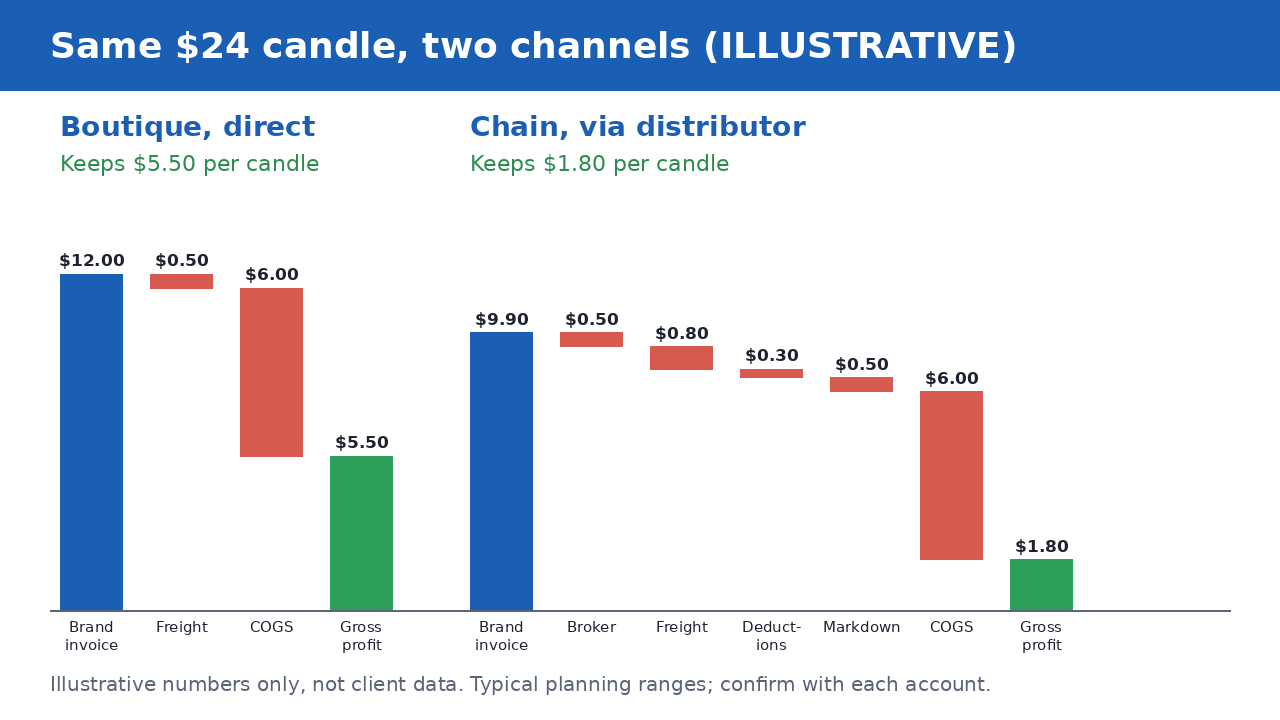
Same candle. Same shelf price. The brand keeps $5.50 in one channel and $1.80 in the other. And $1.80 has to cover samples, displays, a slow-selling scent, and any marketing.
What the two columns look like in real life
Our founder has lived both columns of this table. The boutique column maps to the cost structure he worked with on a specialty store line at Bath & Body Works, White Barn Candle Co., where the brand sells into a specialty retailer. The chain column maps to a different arrangement: while at Belae Brands, he sold the Claire Burke candle line to department stores such as Dillard’s and Kohl’s. On the shelf, the candles can look much alike. What comes back to the brand does not, because each channel carries its own margins, freight, deductions and markdown expectations. The lesson he carries into every engagement is simple: the same candle nets very different dollars by channel, so price per channel, from the shelf back, with every cost on the page.
How to make the math survive
You have a few levers, roughly in order of ease:
- Price for the channel you want next, not the one you have. If a chain is the goal, set retail so the chain waterfall still works.
- Lower landed cost. Vessel and packaging choices often move cost more than wax or fragrance.
- Change size or format so the price per burn hour fits the set while the shelf price supports every margin.
- Ship smarter. Case pack and pallet configuration change freight per unit.
- Negotiate allowances as a total. Look at margin, deductions, and markdown support together, not one at a time.
- Say no to a chain deal that only works if everything goes right.
What to do this week
- Write down your landed cost per candle, including labor and packaging.
- Build two waterfalls: one boutique, one chain.
- Ask your target account for its margin, freight terms, and deduction policy.
- Decide your minimum acceptable gross profit per unit before the buyer meeting.
If you are moving from boutiques toward chains and want a second set of eyes on the math, we would be glad to talk. Vantage Business Consulting helps home fragrance and consumer brands build pricing that holds up in every channel.