The short answer: Six shifts are changing the math for emerging brands: AI as the first stop for product discovery, retailers trimming assortments while selling more ads, creator commerce and TikTok Shop, tariffs and input costs, GLP-1 drugs, and big CPG buying better-for-you brands. Together they make go-to-market harder, so retail readiness matters more.
The shelf is getting smaller, the ad bill is getting bigger, and a growing share of shoppers now ask a chatbot what to buy before they ever walk an aisle. None of these shifts is new on its own. Together, they change the math for an emerging brand trying to win and keep distribution.
We work with founders and sponsors on exactly this problem. Below are the six shifts we are watching most closely, what the recent data says, and what each one means for an emerging brand with limited room for error.
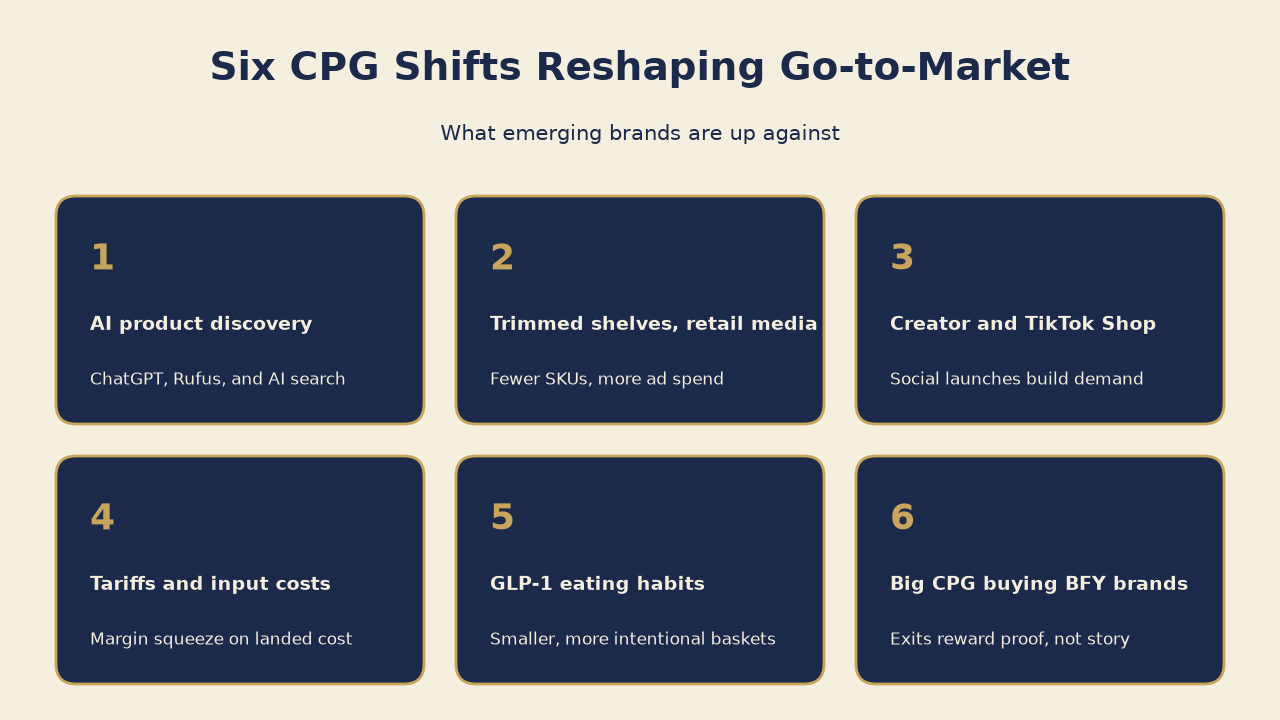
1. AI is becoming the first stop for product discovery
Shoppers are asking ChatGPT, Gemini, Perplexity, and Amazon’s Rufus what to buy, and they are acting on the answers. Adobe reported that traffic from generative AI tools to U.S. retail sites rose 693% year over year in the 2025 holiday season, and that those AI referrals converted 31% better than other traffic. Amazon said in its Q4 2025 results that Rufus was used by more than 300 million customers and helped deliver nearly $12 billion in incremental annualized sales.
What it means for you: AI assistants build answers from what they can read. That means your product detail pages, retailer listings, ingredient and claims language, reviews, and third party mentions. If your content is thin, inconsistent across retailers, or buried in images with no text, you will not be the answer. A big brand with clean data wins the recommendation even if your product is better.
We treat this as retail readiness work, not a marketing experiment. Clean, consistent product content across every listing is now part of getting found.
2. Retailers are trimming assortments and selling more ads
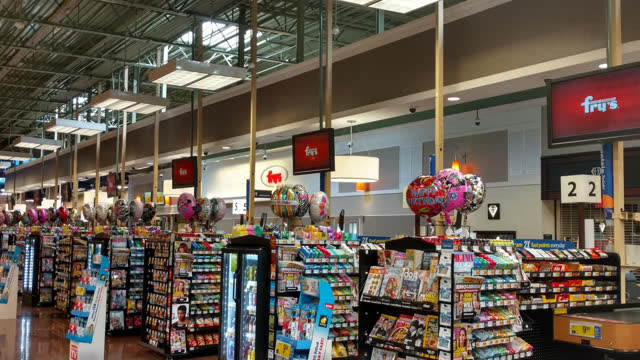
Retailers are cutting SKUs that do not turn. Dollar General’s CEO said on a June 2025 earnings call that the chain cut 1,000 SKUs the prior year, planned to cut more, and called SKU reduction “a big win.” At the same time, retailers are building ad businesses on top of their shelves. EMARKETER forecast U.S. retail media ad spending above $62 billion in 2025, an increase of more than $10 billion year over year, and found that 85% of CPG brands spent with four or more retail media networks in 2024.
What it means for you: Fewer slots, and a buyer who increasingly expects you to bring media dollars with the pitch. Velocity has always mattered. Now it decides whether you survive the next reset, and the buyer will ask how you plan to drive it. We cover what comes next in the first 90 days on shelf.
Our founder saw this from the other side of the table. When he co-founded Innovative Brands, which led the $100M acquisition of Pert Plus and Sure from P&G with Najafi Companies backing, the job was to grow established brands inside tight shelf sets. Both grew about 20% before the business sold to Helen of Troy in 2009. The lesson holds: retailers keep the items with a clear role and a plan behind them.
Before you commit to a new retailer, model the full cost to stay on shelf: slotting, trade, promo, and retail media together. Retail media budgets, promo depth, and trade rates vary widely by category and retailer, so treat any figure you hear as a typical planning range and confirm it with each account. This is where many founders get the math wrong. See our post on retail pricing math for the margin side of it.
3. Creator commerce and TikTok Shop are real launch channels
TikTok Shop is no longer a side test. According to Charm.io, citing TikTok Shop’s head of food, the platform’s food and beverage category more than doubled since early 2024, and the number of larger brands ($30M+ revenue) joining rose 95% year over year in the first half of 2025. Charm also reported that seasoning brand EZ Bombs used TikTok Shop to reach $19M in sales and land in 1,000+ stores, including Walmart and Albertsons, within a year.
What it means for you: Creator content can build demand that a buyer can see, and that gives you leverage in a line review. It can also burn cash fast if affiliate commissions, samples, and paid boosts are not tied to contribution margin. Treat it as a channel with its own P&L, not a free megaphone.
Our founder built the Arizona Hotshots (AAF) brand from scratch in eight months to more than 100,000 social followers, and it was driven by strong content, not big spend. The same principle applies to a snack or personal care brand: consistent, useful content earns attention. Then you have to convert that attention into retail velocity.
4. Tariffs and input costs are squeezing margins
Cost pressure did not ease in 2025. NBC News reported in July 2025 that P&G announced price increases on about 25% of its North American products, averaging roughly 2.5%, citing raw materials, supply chain costs, and tariffs. Conagra said tariffs were likely to raise its cost of goods sold by about 3%. Hershey and Mondelez pointed to cocoa costs.
What it means for you: The big players have scale to absorb and pricing power to pass costs through. An emerging brand often has neither. If your packaging, ingredients, or co-manufacturing touch imported inputs, your landed cost may already differ from what your retail price was built on. Retailers also push back on cost increases from small suppliers harder than on those from category leaders.
We start with a landed cost rebuild by SKU, then look at pack architecture, supplier options, and which accounts can carry a price move. Costs here vary too widely by category to generalize, so the only useful number is your own.
5. GLP-1 drugs are changing how people eat and snack
This one is not hype. A Cornell study published in the Journal of Marketing Research in December 2025, using Numerator purchase data, found that households with a GLP-1 user cut grocery spending 5.3% within six months, with savory snack spending down about 10%. Only a few categories rose, led by yogurt, followed by fresh fruit, nutrition bars, and meat snacks. The share of U.S. households reporting at least one user rose from about 11% in late 2023 to more than 16% by mid-2024.
What it means for you: Fewer, smaller, more intentional eating occasions. If you sell indulgent snacks, expect pressure on volume and a harder case for new items. If you sell protein, fiber, portion control, or nutrient density, there is a real opening, but only if your claims are compliant and your story is clear on the shelf and in AI answers. Pack size is a strategy decision now, not just a cost decision.
6. Big CPG is buying better-for-you brands
Large strategics are paying for growth they cannot build fast enough. PepsiCo closed its acquisition of Siete Foods for $1.2 billion in January 2025 and poppi for $1.95 billion in May 2025, describing both as part of a shift toward “positive choices” and functional products. PepsiCo noted poppi’s community-first approach, including viral TikTok campaigns and influencer partnerships.
What it means for you: The exit path is real, but buyers pay for proof: distribution quality, velocity per store, repeat, and clean margins. A brand with scattered doors and heavy promo reliance does not screen well. Our founder has been on the buy and grow side of these deals. Beyond Innovative Brands, he co-founded Belae Brands with Charterhouse backing and grew revenue across Claire Burke and Vitabath 40% before a sale. Acquirers look past the story to the scorecard.
The common thread: go-to-market is harder, so readiness matters more
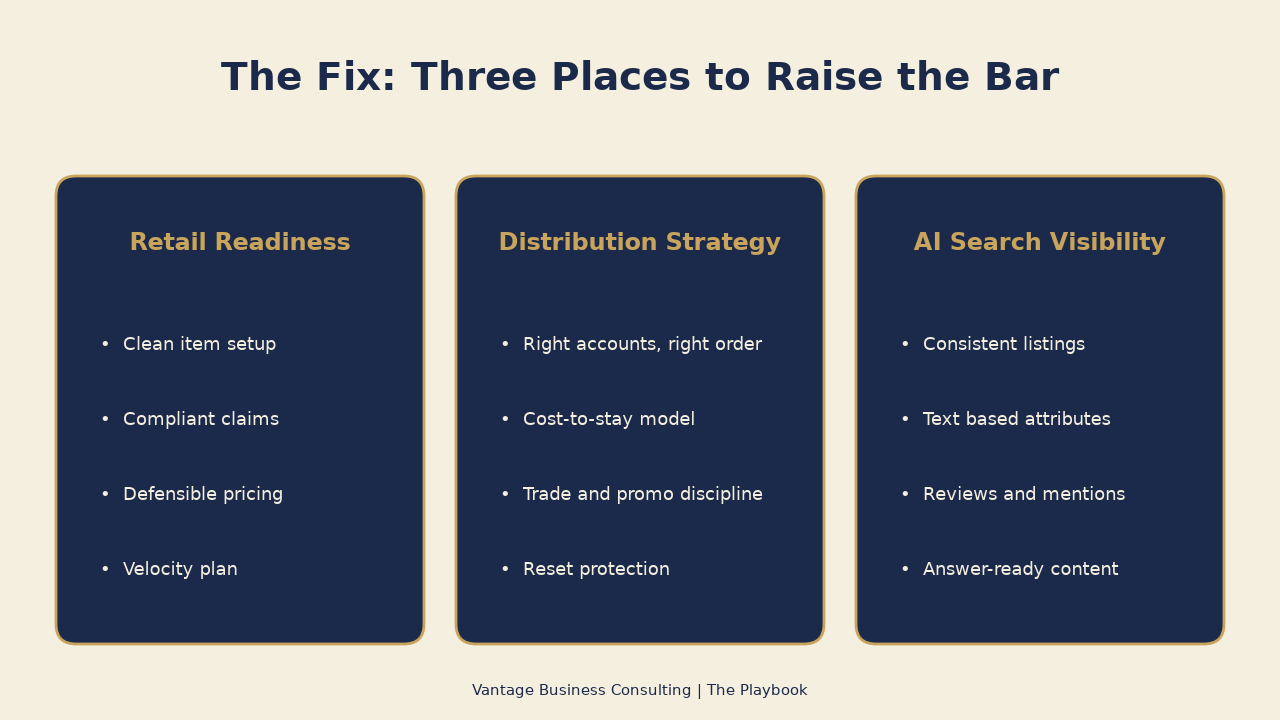
Each shift raises the bar in the same three places:
- Retail readiness. Clean item setup, compliant claims, defensible pricing, and a velocity plan the buyer believes.
- Distribution strategy. The right accounts in the right order, with a full cost-to-stay model, instead of chasing every door. See what your broker should be doing for that side of it.
- AI search visibility. Product content that assistants and retailer search can read, trust, and recommend.
That is the work Vantage Business Consulting does with emerging brands and their sponsors.
What to do this quarter
- Ask ChatGPT, Gemini, and Rufus the five questions your shopper asks. Note who gets recommended and why.
- Audit every retailer listing for consistent titles, claims, ingredients, and text based (not image only) attributes.
- Rank SKUs by velocity per store per week. Decide which ones you would cut before the buyer does.
- Rebuild landed cost by SKU with current input and freight costs.
- Build a cost-to-stay model per account: trade, promo, slotting, and retail media, using typical planning ranges you confirm with each account.
- Put creator and TikTok Shop spend on its own P&L with a contribution margin target.
- Pressure test your portfolio against GLP-1 eating patterns: pack sizes, protein and fiber, portion messaging.
- If an exit is on the horizon, build the scorecard an acquirer will ask for now.
Talk it through with us
If one of these shifts is already showing up in your numbers, we are glad to walk through it with you. Book a call with Vantage Business Consulting at vbuscon.com and we will look at your retail readiness, distribution plan, and AI search visibility together.
Sources
- Adobe, "AI-driven traffic surges across industries with retail experiencing biggest gains" (Jan 12, 2026). 693% YoY gen AI retail traffic, 31% higher conversion, holiday 2025. https://business.adobe.com/blog/ai-driven-traffic-surges-across-industries
- Amazon, "Amazon.com Announces Fourth Quarter Results" (Feb 5, 2026). Rufus used by 300M+ customers, nearly $12B incremental annualized sales. https://ir.aboutamazon.com/news-release/news-release-details/2026/Amazon-com-Announces-Fourth-Quarter-Results/default.aspx
- Supply Chain Dive, "Dollar General sees 'big win' from SKU reduction" (Jun 10, 2025). 1,000 SKUs cut, more planned. https://www.supplychaindive.com/news/dollar-general-sku-reduction-inventory-management/750207/
- EMARKETER, "More than $10 billion in incremental ad spending will flow into US retail media in 2025" (Jan 31, 2025). $62B+ 2025 forecast; 85% of CPG brands on 4+ RMNs in 2024 (Path to Purchase Institute). https://www.emarketer.com/content/10-billion-incremental-ad-spending-will-flow-us-retail-media-2025
- Charm.io, "How TikTok Is Changing the Way Food and Beverage Brands Launch" (Oct 2, 2025). F&B category growth, larger brands joining up 95%, EZ Bombs $19M and 1,000+ stores. https://blog.charm.io/en/blog/how-tiktok-is-changing-the-way-food-and-beverage-brands-launch
- NBC News, "Some companies held off on price hikes as Trump delayed tariffs. That ends soon." (Jul 31, 2025). P&G ~2.5% on ~25% of products; Conagra ~3% COGS from tariffs; cocoa. https://www.nbcnews.com/business/consumer/companies-warn-consumers-prices-rising-tariffs-rcna222349
- Cornell Chronicle, "Ozempic is changing the foods Americans buy" (Dec 19, 2025), on Hristakeva and Liaukonyte, Journal of Marketing Research. 5.3% grocery cut, ~10% savory snacks, household adoption 11% to 16%+. https://news.cornell.edu/stories/2025/12/ozempic-changing-foods-americans-buy
- PepsiCo, "PepsiCo completes acquisition of poppi" (May 19, 2025). $1.95B; references Siete and Sabra. https://www.pepsico.com/newsroom/press-releases/2025/pepsico-completes-acquisition-of-poppi-accelerating-strategic-portfolio-transformation
- PepsiCo, "PepsiCo completes acquisition of Siete Foods" (Jan 17, 2025). $1.2B. https://www.pepsico.com/newsroom/press-releases/2025/pepsico-completes-acquisition-of-siete-foods