The short answer: Before a first purchase order, buyers typically ask for GS1 barcodes in your company’s name, a compliant label, product liability insurance with a certificate naming them as additional insured, a price list that leaves room for every margin, case pack and pallet specs, proof you can fill reorders, and completed vendor setup paperwork.
The buyer likes the product. That is the hard part, right? Not quite. Between a verbal yes and a purchase order sits a stack of requirements. Miss one and the item stalls in setup. Miss it after launch and it can cost you the account.
Retail readiness is the core of what we do at Vantage Business Consulting. This is the list we work through with every client.
The checklist at a glance
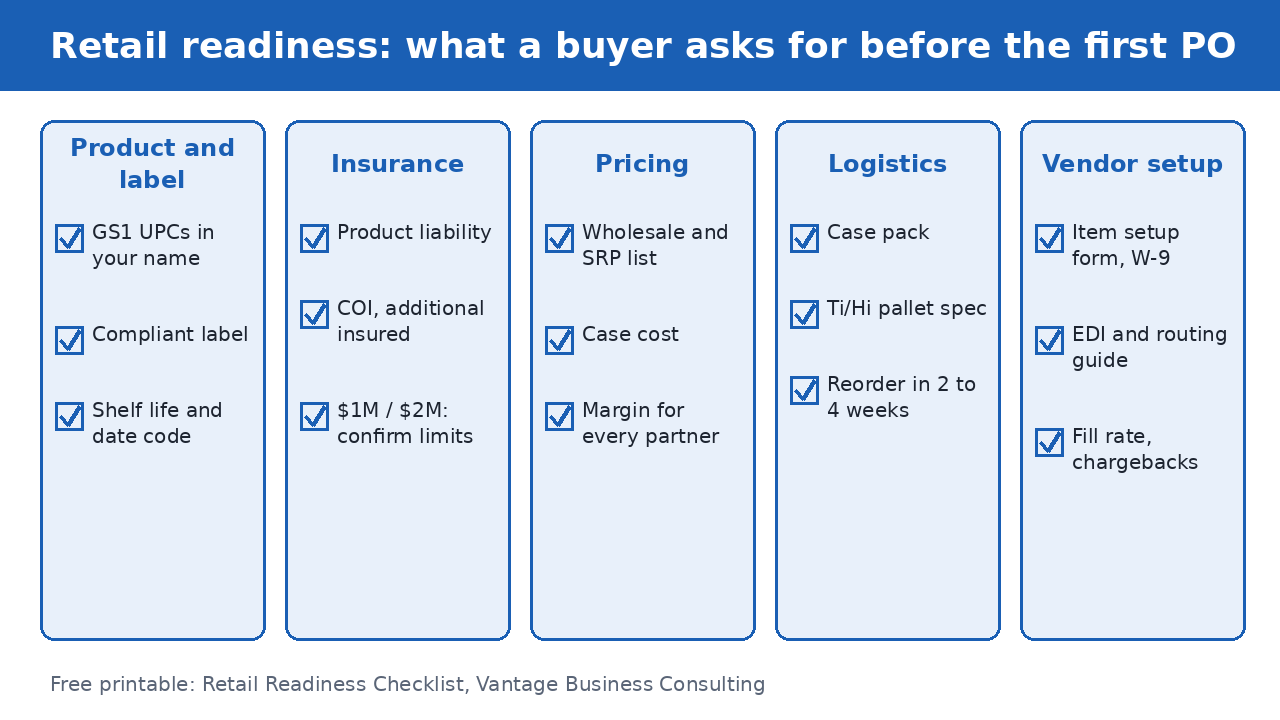
Five groups: product and label, insurance, pricing, logistics, and vendor setup. Each one is below.
1. Barcodes: buy from GS1
Every sellable unit needs a UPC, and cases need their own codes. Mr. Checkout’s guide on how to get a product into stores says codes should be “purchased from GS1 in your own company name” and warns that “recycled or resold barcodes get products delisted.” That is their warning, and it matches our advice: buy directly from GS1 US so the company prefix is registered to you.
2. A compliant label
The label has to meet the rules for your category before a buyer will set it. Mr. Checkout lists a nutrition or supplement facts panel, ingredient list, allergen statement, net weight, and your company name and address. RV Pharma’s guide to getting supplements into retail stores adds, for supplements, the statement of identity and the FDA disclaimer for any structure/function claim. Cleaning and personal care brands have their own rules. Have your label reviewed by someone who knows your category.
3. Product liability insurance and a COI
Buyers will ask for a certificate of insurance (COI) naming them as an additional insured. On limits:
- Mr. Checkout says liability insurance is “commonly $1M per occurrence and $2M aggregate.”
- Many retailers require liability coverage, often $1M to $2M or more.
Treat those as typical planning ranges, and confirm with each account, since requirements vary by retailer. We go deeper on this in insurance before the big box. Talk to your insurance broker early; endorsements can take time.
4. Reorder capacity
A buyer wants to know you will not run out. Mr. Checkout cites “production capacity to fill a reorder in two to four weeks without stocking out,” and suggests having enough on hand to cover the opening order plus one full reorder. RV Pharma makes the same point: line up enough finished goods for the first fill plus at least one reorder. Treat two to four weeks as a typical planning range; confirm with each account.
5. Price list and margin structure
Bring a price list with wholesale price, suggested retail, and case cost. It has to leave room for every partner downstream. Mr. Checkout names margin as the most common reason products get rejected. Our post on shelf price math shows how to work back from the shelf so every margin gets paid.
6. Case pack and Ti/Hi
Buyers and distributors need units per case, case dimensions and weight, and pallet configuration. Ti/Hi is the number of cases per layer (Ti) and the number of layers (Hi) on a pallet. Mr. Checkout notes small stores commonly want case packs of 12 or 24. Get these specs right before you print shipper cases; changing them later is expensive.
7. Item setup
Expect a new item form with every data point above, plus images, dimensions, shelf life, and country of origin. Errors here show up later as wrong shelf tags or receiving problems. One owner, one master spreadsheet.
8. Fill rate and chargebacks
Larger retailers measure how completely and how on time you fill orders. RV Pharma notes that routing guide violations “lead to chargebacks that can quietly erase your profit on an order,” and that payment terms of 30 to 60 days or longer are common. Read the vendor guide and routing guide before the first ship date, and budget a reserve for deductions.
9. Vendor onboarding
RV Pharma lists what to expect after the yes: a vendor agreement, new item form, W-9, certificate of insurance, and, in larger accounts, EDI setup for purchase orders, ship notices, and invoices. Some retailers also ask for introductory allowances, free fills, or slotting. Model those costs before you accept.
Before the meeting, not after
Our founder has spent 34 years in consumer brands, including launching White Barn Candle Co. and Wallflowers at Bath & Body Works and co-founding Innovative Brands. The pattern we work from is simple: the brands that get through setup cleanly had the paperwork done before the pitch. Buyers remember the vendor who sent a complete packet the same day.
Once you ship, the work shifts to sell-through. Our post on what buyers watch in the first 90 days covers what comes next.
What to do this week
- Print the Retail Readiness Checklist and mark every item done, in progress, or missing.
- Confirm your UPCs are registered to your company with GS1.
- Call your insurance broker about limits and additional insured endorsements.
- Build your case pack and pallet spec sheet.
- Write down your reorder lead time and check it against your inventory.
If you want a second set of eyes on whatever is still marked missing before your next buyer meeting, grab 15 minutes with us. Helping founders get retail ready is the heart of Vantage Business Consulting.