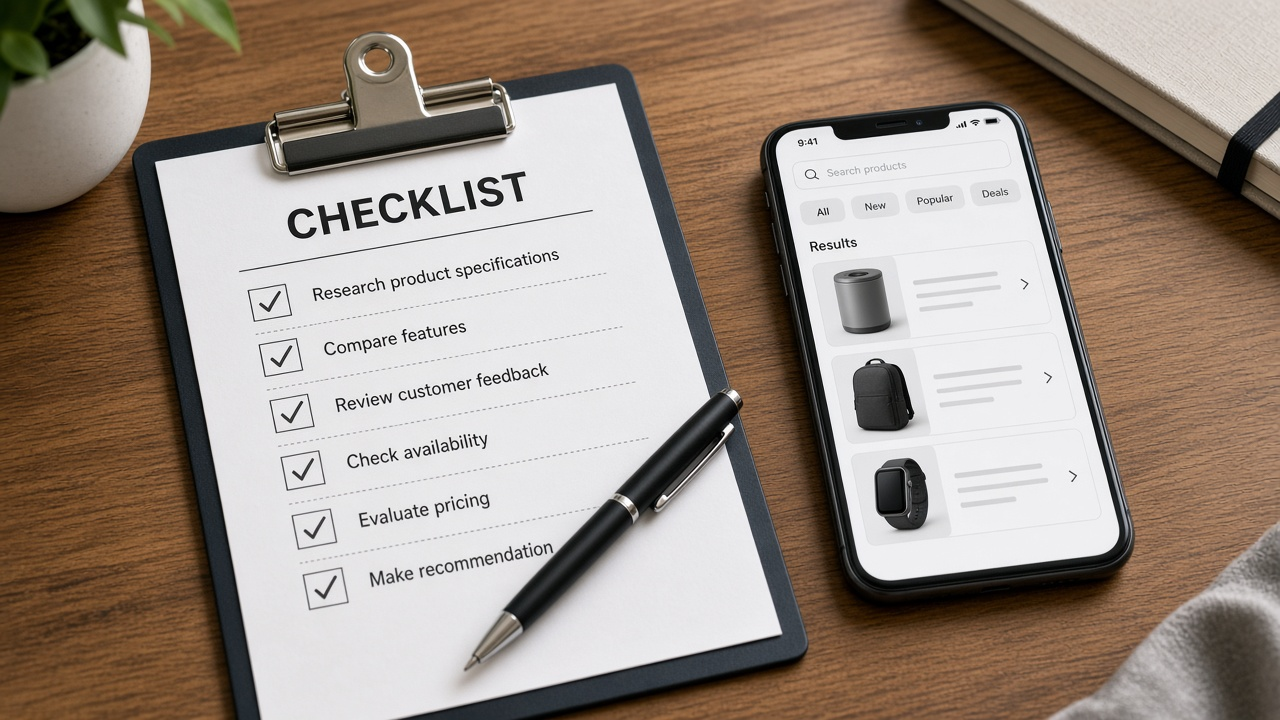
The short answer: Treat your shelf and your digital presence like a search result. Name the product plainly, make the hero SKU easy to find, answer the shopper's question before they ask it, and prove it with reviews.
Amazon did not just build a store. It taught a habit.
Type what you want. See a ranked list. Check the price. Scan the reviews. Decide in seconds.
That habit did not stay online. It walked into the store with the shopper. Search-first shopping is now the default way people buy, whether they are on a phone, on a retailer site, or standing in front of a shelf with a question in their head. If your brand is hard to find, hard to read, or hard to trust in that first few seconds, you lose. Not to a better product. To a clearer one.
The habit, in plain terms
A shopper who searches “gentle body wash for dry skin” does not want a brand lecture. She wants a short list, a price, a star rating, and a reason to pick one. She expects the answer to be ranked. She expects to compare without work.
Then she walks into a store and expects the same thing. Which one do I buy? What is it for? Is it worth the price?
Our founder spent years inside CPG doing the opposite of this without knowing it. At Dial, brand work was about the pack, the promise, and the shelf. At Bath & Body Works, the store was the search engine, and the associate and the display did the ranking for you. Both taught him the same thing from different directions: the shopper is always sorting, and the brand that makes sorting easy gets picked. What changed is that the sorting now starts on a screen, before anyone reaches the aisle.
That has a P&L consequence. When a shopper cannot sort you quickly, you pay for it somewhere. You pay in promo to force a trial. You pay in ad spend to buy the click you should have earned. You pay in returns and bad reviews when the wrong person buys the wrong item. Confusion is not free. It just shows up on a different line.
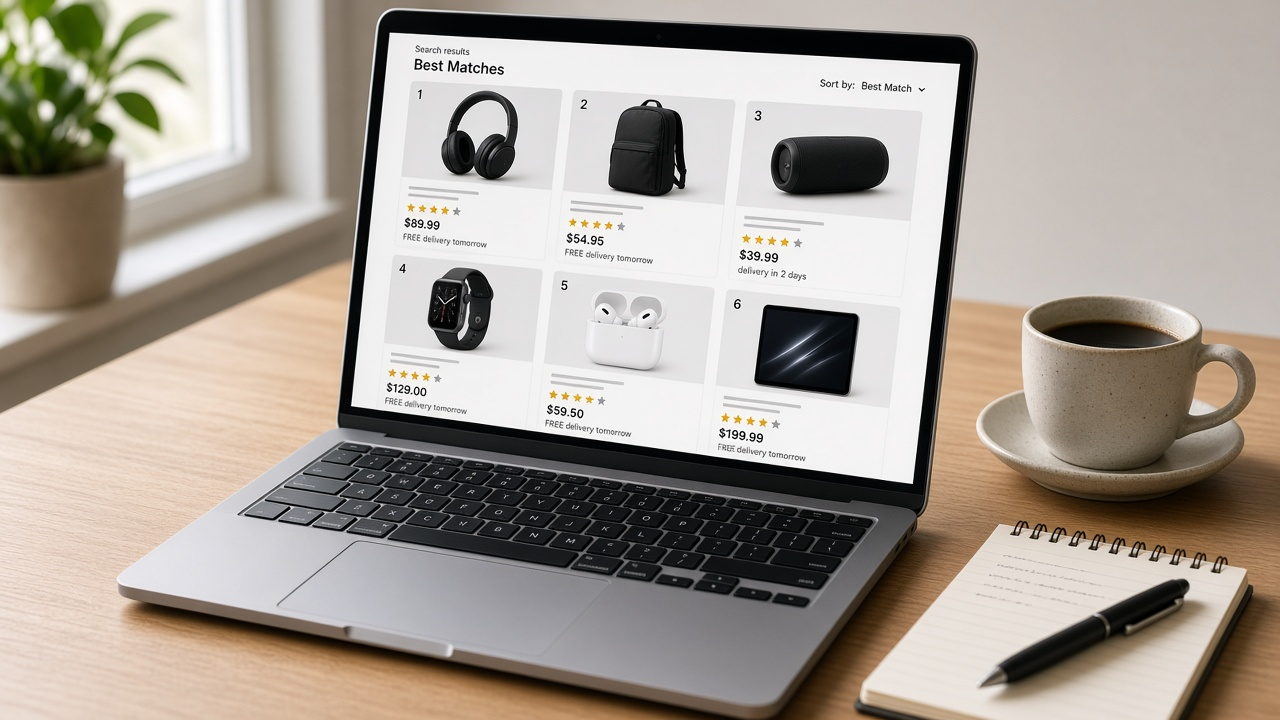
Your shelf is a search result
A search result is a title, an image, a price, a rating, and a snippet that says why it matches. Most brands we walk into fail on at least three.
Naming. The title is the query match. If a shopper types the need and your product name does not contain the need, you are asking the algorithm and the human to guess. “Serenity Collection Body Wash” is a brand exercise. “Fragrance-Free Body Wash for Dry Skin, 16 oz” is a search result. You can keep the brand voice. You cannot skip the plain words.
The hero SKU. Every result list has a top result. If your line has twelve items and none is obviously the one to start with, the shopper picks by default, and default usually means the cheapest or the most familiar name. We wrote about this from the assortment side in Your Hero SKU Is Lying to You. The search side is the same problem. A clear hero is the first row of the results page. Make it the easiest item in the set to find, on the shelf and online.
Images. The image is the thumbnail. It has to work small. One clean front-of-pack shot, then images that carry the claims: what it is for, what is in it, how big it is, how it is used. If the first image needs a caption to make sense, it is not doing its job.
Claims. A claim only helps if it is specific and easy to verify. “Made with care” is filler. “Fragrance-free” or “dermatologist tested” (only if you can back it) is something a shopper can act on. Say the thing the shopper is filtering on.
Reviews. Reviews are the ranking signal you do not fully control, and the one shoppers trust most. Thin or stale reviews read as risk. Buyers see it too.
Answer the question before it is asked
The best content does not sell. It answers.
Every product has a short list of questions a shopper is silently asking. Is this for me? Does it do what I need? How big is it? What is in it? How does it compare to the one I usually buy? Is it worth this price?
If your title, images, and bullets answer those, you win the moment. If they make the shopper hunt, she leaves for the next result. In a search-first world the next result is one tap away. On a shelf it is one arm’s length away.
The same plain, specific content that helps a shopper sort you is what search engines and AI assistants can read and repeat. No separate strategy needed.
A framework you can run this month
Here is the sequence we use when we look at a brand’s discovery gap. It is not fancy. It is ordered so the cheap fixes come first.
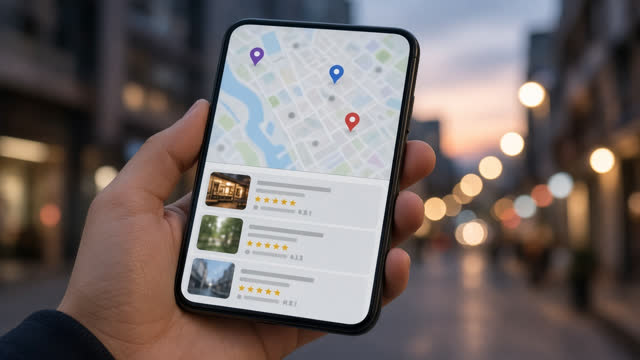
- Run your own search. Type the five phrases a shopper would use to find your category, on Amazon, on your biggest retailer’s site, and in a regular search engine. Write down where you show up, what the title says, and who ranks above you. Do it on your phone. That is where the shopper is.
- Rename for the query, not the deck. Rewrite titles so the product type, the key benefit, and the size are in plain words, in a consistent pattern across the line. Keep the brand name in front. Keep the creative names for the pack and the story, not the search field.
- Pick and stage the hero. Name one hero SKU. Make it the lead listing, the first facing, the item in every image set. Give it the most complete content and the most review attention. Everything else in the line should point back to it.
- Build the image stack. Front of pack first. Then benefit, ingredients or specs, size and scale, and use. Check that every image reads at thumbnail size.
- Tighten the claims. List every claim on pack and online. Keep the ones you can prove and the ones a shopper actually filters on. Cut the rest. Make sure the pack, the listing, and the retailer content say the same thing.
- Work the reviews on purpose. Look at what people say, not just the average. Recurring complaints are a content problem or a product problem, and you should know which. Recurring praise is copy you did not have to write. Use it.
- Check price against the results page. Shoppers see your price next to the alternatives, not alone. If the gap is unexplained, the content has to explain it. If the content cannot, the price is the issue. The math behind that is in How to Price a Consumer Product So Retailers Say Yes.
Most of the gap shows up in the first three steps.
If you want a second set of eyes on your own search results, grab 15 minutes with us and bring your top five queries.
What this means for the buyer meeting
Our founder has bought divested brands and sold to buyers. The pattern on both sides is the same. A buyer is a professional searcher. Before the meeting, they have looked you up. They have seen your listing, your reviews, and your price against the competition. If your digital presence is thin or inconsistent, you are starting the meeting on defense.
A brand with clean naming, a clear hero, complete content, and steady reviews walks in with proof. The conversation moves from “why should I believe you” to “how much can you support.” That is a better meeting and a better margin conversation. It also connects to shelf economics. Space is priced whether you model it or not, as we covered in Retailer Margin Requirements and Markdown Strategy. A hero that is easy to find and easy to buy turns faster, and turns are what pay for the facing.
When our founder looks at a brand for a possible acquisition, this is part of diligence. Easy to find and well reviewed means demand he can see. Hard to find means a hidden cost to fix, and it goes into the price.
Retail-readiness checklist
Print this. Run it before your next retailer review or listing refresh.
Findability
- Product titles include product type, key benefit, and size in plain words
- Naming pattern is consistent across the whole line
- You have searched your top five shopper queries on your phone and know where you rank
- Category, attributes, and keywords are complete on every retailer listing
Hero SKU
- One hero SKU is named in writing
- The hero is the lead listing and the first facing
- The hero has the most complete content and the most review attention
- Supporting items clearly point back to the hero
Content
- First image reads at thumbnail size
- Image stack covers benefit, ingredients or specs, size, and use
- Every claim is specific, provable, and consistent across pack, site, and retailer
- Bullets answer who it is for, what it does, and how it compares
Proof
- Review count and recency are healthy on the hero
- You have read the actual review text and logged recurring complaints and praise
- Price is explained by the content when it sits above the alternatives
Operations
- Item data, images, and pack specs match across every retail and marketplace listing
- Inventory and availability support the listing you are driving traffic to
- Someone owns the listings and reviews every month
The takeaway
Search-first shopping is not a channel. It is a habit, and retail has to win it on the shelf and online.
Shoppers want to type what they need and see a clear, ranked, priced, reviewed answer. Give them that. Name the product plainly. Stage the hero. Answer the question before it is asked. Prove it with reviews.
Brands that do this get picked because they were easy to pick. That is cheaper than promo and cheaper than ads, and it shows up in the P&L. For the commercial mistakes that make brands harder to pick, see The 7 Biggest Go-to-Market Mistakes CPG Founders Make.