The short answer: Non-alcoholic beer, wine and spirits are still growing while traditional alcohol declines, per NIQ data reported by BevNews and Beer Business Daily, but NA beer growth has slowed and retained buyers spend slightly less. Our read: fund repeat purchase and a clear price tier before chasing more distribution.
At Vantage Business Consulting we work with beverage brands that are already on shelf and defending margin. This is the third post in our Our Read series.
What is happening
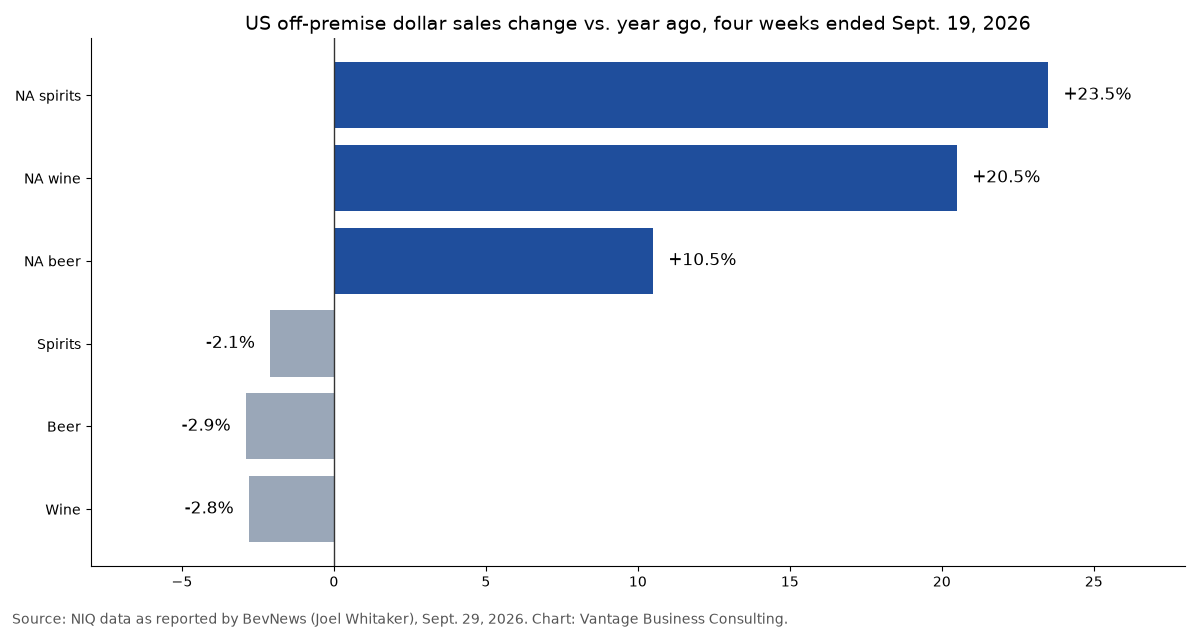
- BevNews’ Joel Whitaker reported on Sept. 29, 2026 NIQ data for the four weeks ended Sept. 19, 2026. Total alcohol dollars were $8.4 billion, down 2%, with case volume down 3.7%. Beer fell 2.9% in dollars, wine 2.8% and spirits 2.1%.
- In the same period, NA beer grew 10.5% in dollars and volume, NA wine grew 20.5% in dollars and 17.2% in volume, and NA spirits grew 23.5% in dollars and 18.7% in volume.
- Beer Business Daily reported on Sept. 1, 2026 an NIQ analysis by 3 Tier Beverages’ Danelle Kosmal. NA beer dollars were up 9.4% year to date and 10.2% for the 13 weeks to Aug. 8, against 15.7% in the same 13 weeks a year earlier.
- In the same analysis, super premium NA beer grew 53% at an average case price of $35.37, against $42.57 for craft and $42.11 for imports, which Kosmal says has “essentially created a new, more mainstream price tier.” Five brands drove 70% of NA beer growth.
- NA ready-to-drink products were up 34.9% over those 13 weeks and held a 7.1 share of NA adult beverage dollars.
- NIQ Omnishopper Panel data in the same piece, for the 52 weeks ending July 11, 2026, shows nearly half of NA beer dollars came from new buyers, while retained buyers’ average NA beer spend fell about $1.00 on fewer trips.
- Dry Atlas posted findings on Oct. 27, 2026 from a YouGov survey (n=1,149, Oct. 14 to 15): 18% of US adults 21+ drank an alcohol alternative in the past six months. From a separate Prodege buyer survey (n=1,003), price was the top in-category barrier at 46%.
Why it matters on the P&L
Growth that leans on trial is fragile. If half your dollars come from first-time buyers, a slowdown in new buyers shows up fast. Buyers read repeat as the signal. See what buyers watch before reorder.
A new price tier resets the shelf. A lower mainstream tier pulls shoppers who were never going to pay craft prices, and it puts pressure on every premium SKU next to it. Run the math in shelf price margin math.
Concentration cuts both ways. When five brands drive most of the growth, a reset can trim the tail quickly.
Our read
This section is our opinion. We read the non-alcoholic numbers as a category maturing, not cooling off. The easy trial gains are behind it. The next phase rewards brands that earn the second and third purchase. We would not answer slower growth with deeper promotions; that buys trial again and trains shoppers to wait. See promo without the hangover. We would also not assume NA beer owns the moderation shopper. RTDs are taking occasions, and a beer brand that ignores them is defending one door of a wider room.
What an established brand should do this quarter
- Split your data into new versus repeat buyers. If you cannot see it, ask your retailer or panel provider before Q1 planning.
- Build one repeat program tied to occasions, such as game day, holidays and Dry January, with reminders rather than discounts.
- Map your price against the new tier. Decide on purpose whether you sit above it with a clear reason, or meet it with a pack or size change.
- Test one RTD or adjacent format at small scale before a competitor takes the occasion.
- Trim the tail of SKUs that are not pulling repeat before the next reset.
This is business analysis, not legal advice. Have counsel review any labeling or claims questions.
Next step
If you are planning a relaunch or a new format for 2027, the free Launch Readiness Scorecard takes about three minutes and shows where the gaps are.