The short answer: Home fragrance is growing on price, not volume; Circana data reported by Happi shows candle and air freshener dollars roughly flat for the 52 weeks ended June 14, 2026, on falling units. Our read: cut slow SKUs and earn the premium through affordable luxury rather than imposed price.
At Vantage Business Consulting we work with home and personal care brands that are already on shelf and defending margin. This is the second post in our Our Read series.
What is happening
- Happi’s Melissa Meisel reported on Sept 2, 2026 Circana data for US multi-outlet for the 52 weeks ended June 14, 2026. Household air fresheners were $4.29 billion, up 0.2%, on units down 3.2% and price per unit up 3.5%. Candles were $2.47 billion, up 0.1%, on units down 1.3% and price per unit up 1.4%.
- In the same table, electronic dispensers fell 2.4% in dollars, potpourri and sachets fell 7.3%, and essential oils fell 13.2%. Odor controllers rose 5.7%.
- Happi also quotes Nest New York’s CMO saying the lines between home and fine fragrance “continue to blur.”
- Bath & Body Works reported on Aug 26, 2026 Q2 net sales of $1.514 billion, down 2.3%, with US and Canada store sales down 5.4%. On the Q2 earnings call, management said home fragrance declined low single digits, partly offset by single-wick candles and Wallflower heaters, and launched a Reserve Collection with a four-wick candle and liquidless reed diffusers, starting at “seed scale.”
- Newell Brands, owner of Yankee Candle, reported on July 31, 2026 core sales growth in Home Fragrance for Q2, and flagged “higher-than-anticipated commodity and transportation costs.” Both companies booked IEEPA tariff refunds in the quarter: about $80 million at Bath & Body Works and about $100 million pretax at Newell.
Why it matters on the P&L
Price is doing the work. Flat dollars on falling units means the category lives on price per unit. Price you impose is thin cover. Price you earn through position holds.
Shelf math. Buyers rank by dollars per linear foot and turns. A SKU holding dollars on fewer units is a reset candidate. See what buyers watch before reorder.
Cost side. Tariff refunds are one-time. Freight and commodity pressure is not. Bath & Body Works also chose less clearance and fewer seasonal SKUs, which is a margin decision.
Our read
This section is our opinion. A higher price you earn is different from one you impose. It holds when shoppers see a reason for it, and that reason comes from differentiation and position. The more a shopper sees your candle or air freshener as a commodity, the more price pressure you will have, whatever the list price says.
The way to earn the premium is to position the product as affordable luxury, a treat that still feels within reach. In our founder’s experience, there are four ways to do it:
- A luxurious fragrance. A scent that feels like fine fragrance, not a shelf filler, is the base of any premium story.
- A new way to deliver fragrance to the home. Our founder saw this while developing White Barn and Wallflowers. New delivery formats, such as concentrated room spray, a crystal jelly jar (a static room freshener) and the Wallflower plug-in, gave shoppers a reason to pay more than the commodity price.
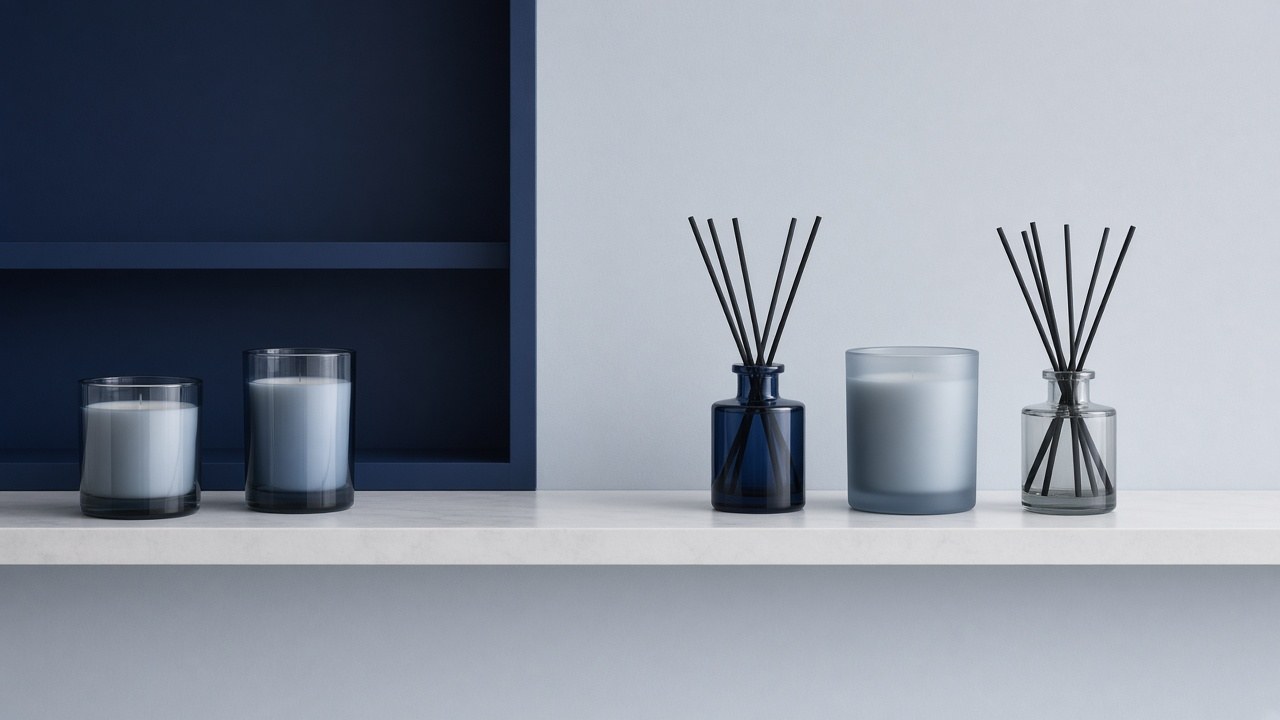
- A better vessel or format. A reed diffuser, a multi-wick candle or a refill system signals more value than a plain jar.
- A clear step-up story. The shopper should understand in seconds why this item costs more than the one next to it.
This category also moves in cycles. In our founder’s experience, luxurious scents and new delivery formats lead each upswing, and we read flat dollars on falling units as part of one. We would not chase volume with more seasonal SKUs or deeper promotions, and we would not read a tariff refund as margin recovery. Brands with shelf space should use it to trade up, not to defend every item.
What an established brand should do this quarter
- Run a units, not dollars, SKU review. Flag items where price is masking unit decline and ask a plain question: would a shopper see this as a commodity? Then decide: differentiate, consolidate or exit. Start with your hero SKU.
- Build one premium tier on purpose. Pick one of the four routes above: a luxurious fragrance, a new delivery format, a better vessel, or a clear step-up story. Price it with shelf price margin math before it goes to a buyer.
- Cut seasonal tail and clearance exposure before Q1 planning.
- Strip one-time tariff refunds out of your margin view and re-quote freight and raw materials now.
- Check fragrance and labeling compliance on any new format or retailer, including supplier IFRA documentation and state rules.
This is business analysis, not legal advice. Have counsel review any labeling or regulatory questions.
If you want a second set of eyes on your SKU list or price ladder, book a 15-minute call with our founder, Carlton Hawkins.
Sources
| Source | Publisher | Date |
|---|---|---|
| Luxurious Layers Lead in Home Fragrance | Happi (Melissa Meisel) | Sept 2, 2026 |
| Bath & Body Works Q2 2026 earnings release (Ex. 99.1) | Bath & Body Works, Inc. (SEC filing) | Aug 26, 2026 |
| Bath & Body Works Q2 2026 Earnings Call Transcript | MarketHundred (transcript aggregator) | Aug 26, 2026 |
| Newell Brands Announces Second Quarter 2026 Results | Newell Brands (Business Wire) | July 31, 2026 |
Circana figures are as published by Happi. We did not see the underlying Circana data.