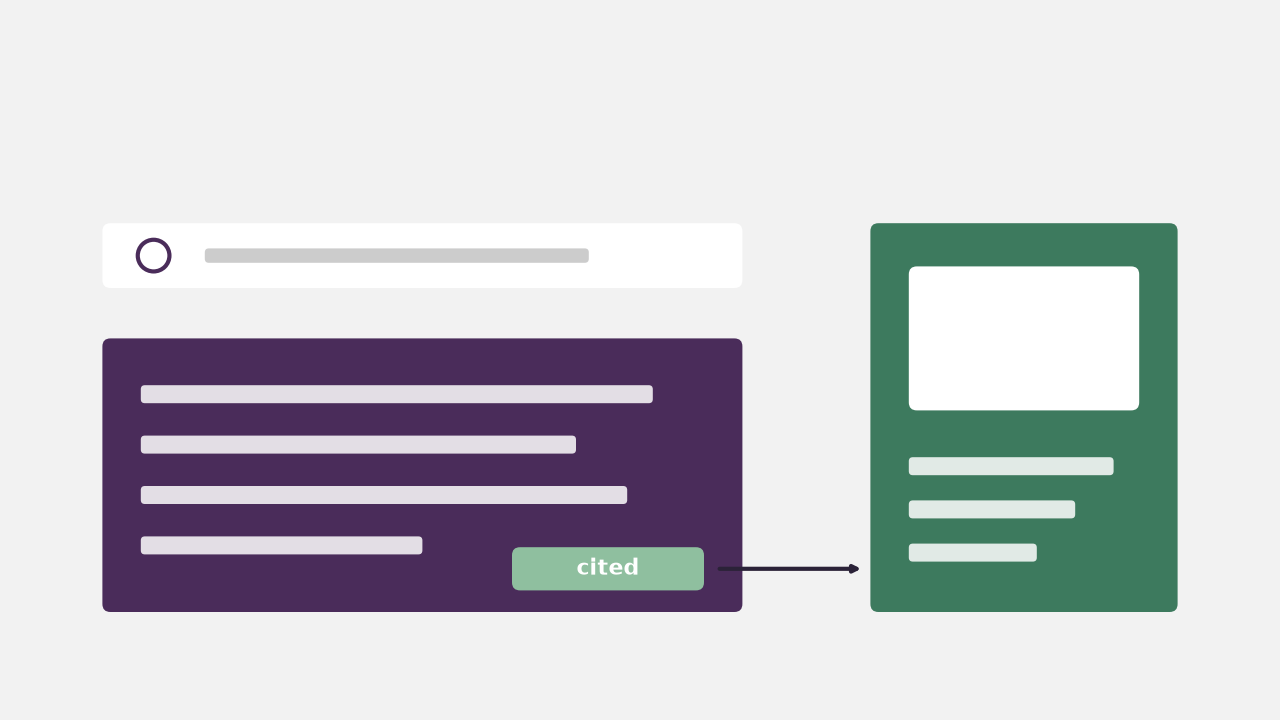
The short answer: AEO and GEO extend traditional SEO to generative search interfaces. While SEO targets rankings and clicks on SERPs, AEO/GEO aims for brand citations and recommendations within AI-generated responses. Focus on technical clarity, structured product data, and third-party authority. Our read: fix your own product and FAQ pages first, then earn third party reviews and coverage.
What the terms mean, in plain words
For digital marketers, AEO (Answer Engine Optimization) and GEO (Generative Engine Optimization) are best understood as the next iteration of On-Page SEO, Technical SEO, and Digital PR combined.
AEO builds on rich snippets, schema markup, and direct answers, targeting single-query conversational answers. GEO functions like multi-source algorithmic synthesis, where AI aggregates information across brand sites, reviews, and publishers to generate recommendations. In SEM terms, while paid search buys top-of-page real estate directly, GEO earns high-value recommendation real estate through contextual relevance and authority signals.
Traditional SEO measures organic sessions, impressions, and Click-Through Rate (CTR). In AEO/GEO, key metrics shift to Share of Voice (SoV) in AI answers, citation presence, and referral traffic conversion quality.
What the data says
The research is new, mostly from vendors who sell tools in this space, and it does not all agree. Here is what we could verify, with dates.
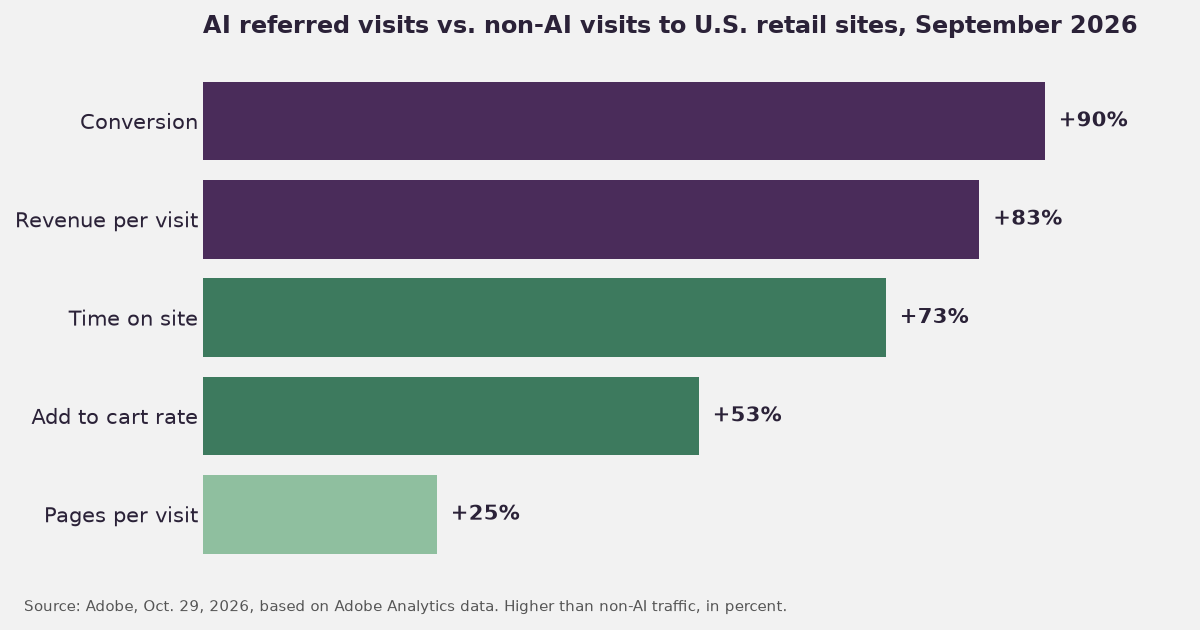
- AI referred shoppers now convert better. Adobe reported on Oct. 29, 2026, based on Adobe Analytics data, that in September 2026 AI traffic to U.S. retail sites grew 71% year over year. Adobe reported that in September 2026, AI traffic to U.S. retail sites converted 90% better than non-AI traffic. In August 2025, Adobe says, it converted 9% worse. AI visitors also spent 73% more time on site, viewed 25% more pages, added to cart at a 53% higher rate, and generated 83% higher revenue per visit.
- Many shoppers use AI, and most check it. Product.ai’s Trust in AI Commerce Report, published Oct. 14, 2026, found 41.5% of U.S. online shoppers used an AI assistant to research a purchase in the past 90 days (n=1,247). Of those AI users, 89.9% verified the recommendation through another source before buying. Among shoppers who verify, 36.7% checked online customer reviews first, 21.9% a search engine, and 14.0% the brand’s or retailer’s own website.
- Brand sites are a major citation source. Parse analyzed 3,805,095 recommendation citations in two major AI search tools from May 24 through Aug. 23, 2026 (published Aug. 29, updated Oct. 12). The recommended brand’s own website supplied 28.2%. Independent publishers supplied 35.2%.
- Consumer goods lean on independent sources. In the same Parse study, in consumer goods, the brand’s own site supplied 15.68% of citations and independent publishers 45.98%. In food and beverage it was 16.1% and 51.69%.
- Different AI tools read different sources. Rempa studied 7,911 answers from three AI assistants (published Oct. 28, 2026). On the same question, two of the assistants shared 8.3% of their cited sites on average. When an answer cited the brand’s own site, it named the brand 97% of the time, against 18% when it did not. Rempa notes that link is a correlation, and its sample was mostly French brands.
What is thin: no study we found measures how much revenue AI answers drive for a typical mid-size e-commerce brand. Adobe does not publish AI’s share of total retail traffic, so a large growth rate may sit on a small base.
Can a brand actually influence being cited?
Yes, within limits. The Parse and Rempa data both say brand websites are a large share of what gets cited, so your own pages are not a lost cause. Adobe’s data adds that content which explains, such as product details, buying guides, FAQs, and return policies, is what AI reads best.
The limit is the consumer category itself. In consumer goods, independent publishers supplied a larger share of AI recommendation citations than brands’ own sites, so your pages alone are not enough. Reviews and editorial roundups carry weight you cannot write yourself, only earn.
Nobody can promise a placement. AI answers vary by tool and by session, and the tools disagree with each other.
Our read
Put plainly, established brands should fix their own product and FAQ pages first, then earn third party reviews and coverage.
Our read is that AEO and GEO require the same fundamentals as robust SEO and Digital PR: optimized product metadata, structured schema, authoritative backlink profiles, and third-party media placements.
Treat AEO/GEO as an enhancement to your existing search stack, not a complete replacement. Winning brands maintain strong technical SEO fundamentals, clear entity associations, and authentic review coverage. We covered the marketplace counterpart of this strategy in Amazon taught shoppers one habit.
We would not hire anyone who sells guaranteed AI rankings. Shoppers still check reviews and brand sites before they buy, so pages built for people tend to be the pages AI can quote.
What an established brand should do this quarter
- Run the questions. Write the 20 questions a shopper asks before buying in your category and see which brands AI answers name. Repeat monthly in more than one tool.
- Rewrite your top product pages so the first lines state what it is, who it is for, and how it compares, in plain text.
- Build real FAQ sections from support tickets and low star reviews, one direct answer per question.
- Grow review volume on your site and retail listings, with permission rules for reuse.
- Earn independent coverage: category roundups, trade press, and honest comparison pages.
- Track AI referral traffic separately in analytics so you can see conversion for yourself.
For how search, AEO, and AI search fit together, see the digital discovery stack.
A disclosure
Our founder, Carlton Hawkins, is part of Clear Discovery, an SEO and AEO firm in Gilbert, AZ, so we are affiliated. Clear Discovery (“Be found. Be chosen.”) is in a soft launch, with its scanning tool launching officially November 9. Its blog is The Found Report. You can see it at cleardiscovery.ai.
This is business analysis, not legal advice. Sources and dates are listed below. Several studies come from companies that sell AI visibility or verification products.
Next step
At Vantage Business Consulting, we help established brands decide where discovery work pays back. If you are planning a channel push for 2027, start with channel sequencing.
Sources
- Adobe, “Adobe report: AI traffic now generates 83% higher revenue per visit for U.S. retailers heading into the holiday shopping season,” Vivek Pandya, Oct. 29, 2026. https://business.adobe.com/blog/ai-traffic-higher-revenue-per-visit-retail-holiday
- Product.ai Research, “The Trust in AI Commerce Report, Edition 2,” Oct. 14, 2026. https://product.ai/research/trust-in-ai-commerce-report/
- Parse, “Who publishes the pages AI cites for buying advice?,” Dimitry Apollonsky, Aug. 29, 2026, updated Oct. 12, 2026. https://parse.gl/research/who-publishes-the-pages-ai-cites
- Rempa, “What AI assistants cite: 32,000 sources from 7,400 answers,” Oct. 28, 2026. https://rempa.ai/studies/what-ai-assistants-cite/