The short answer: Find co-packers through referrals from other brands, trade associations, trade shows and ingredient suppliers, since no single directory exists. Vet each on product experience, certifications and audits, allergen controls, capacity, MOQ and lead time. Check MOQ times unit cost against shelf life and sell-through, and put food safety and recall roles in the contract.
At some point a growing food, beverage, or supplement brand has to hand the making to someone else. Done well, a co-packer gives you capacity, credibility with buyers, and a cost you can plan around. Done badly, it ties up your cash and your reputation at the same time.
There is no central directory
Founders expect a master list. It does not exist. Bettr Manager’s guide to finding and vetting a co-packer says it directly: “There is no single directory of co-packers, so finding one is mostly legwork.”
One commenter on r/foodscience, who said they work for a sourcing platform, described founders calling “10 to 20 facilities before finding one that will even respond,” and noted that “some want 500 units, others want 50,000.” That is one person’s observation, and they have a commercial interest, but it matches what founders tell us.
Where to search
Bettr Manager lists the channels that work: referrals from other small brands, industry directories and trade associations, matchmaking brokers and consultants, trade shows, and ingredient and equipment suppliers. In a Food Business News interview, SKU mentor Richard Riccardi, who co-owned a custom food processor for more than two decades, adds two ideas: check state food processor associations, and look at which co-packers your competitors use.
Our addition: start with your process and packaging, not your category. A plant that fills hot into glass is a different universe from one that runs powder into stick packs.
The vetting questions
Ask every candidate the same questions so you can compare them side by side.
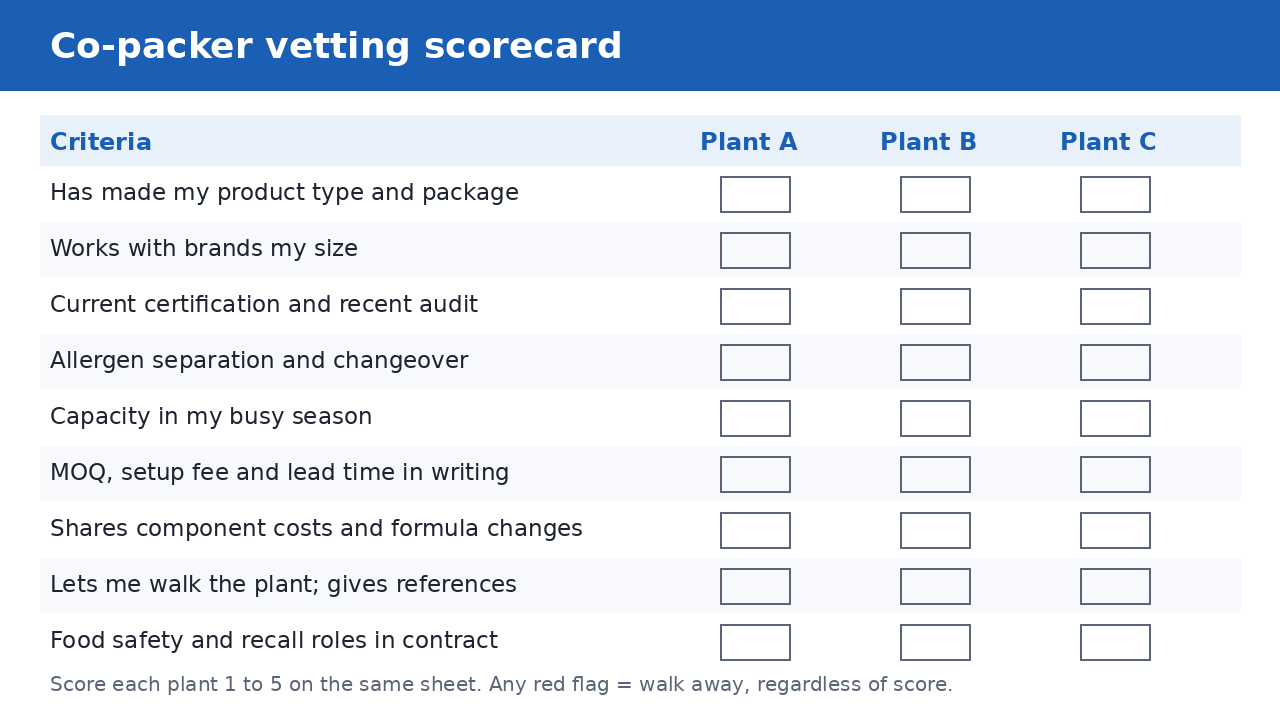
Fit and experience. Riccardi’s first questions: “Do you have experience making my product?” and “Do you work with companies my size?” He warns that a small brand inside a large plant is usually not sustainable.
Certifications and audits. Which food safety certification does the plant hold, and when was the last audit? Bettr Manager notes that SQF, BRCGS, and FSSC 22000 are GFSI benchmarked schemes, and that a retailer may require a specific one. Supplements bring their own requirements, such as cGMP.
Allergen controls. If you carry allergens, or claim to be free of them, ask exactly how the plant separates lines, cleans, and validates changeovers.
Capacity. Do they have room during your busy season? What happens when a bigger customer needs the line?
MOQ, setup fees, and lead time. Get all three in writing before you fall for the plant.
Records and recall roles. Who owns the food safety plan for your runs? Who keeps which lot records? Who runs a mock recall?
Score each plant on the same sheet. A current certificate is the floor, not the answer. Bettr Manager puts it well: “The audit tells you the room passed on one day; the references tell you what running with them is like.”
The MOQ cash trap
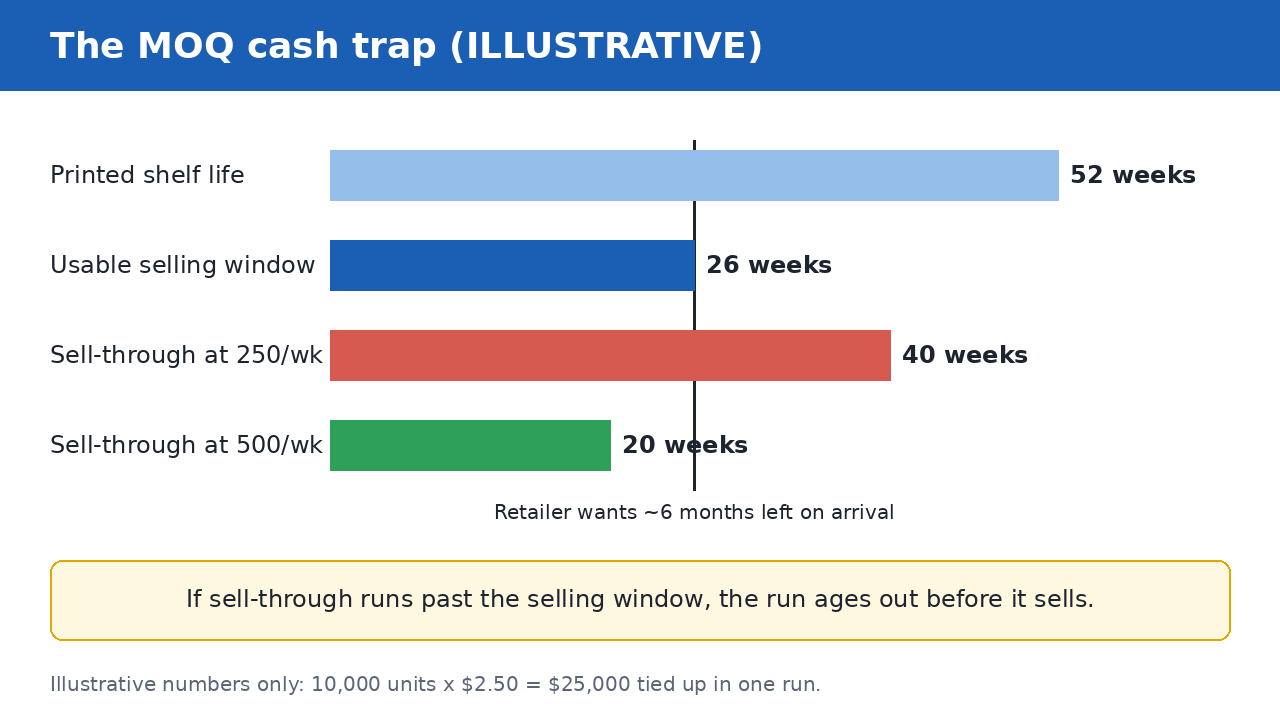
This is the math we see founders skip. Bettr Manager frames it simply: multiply the minimum order quantity by your per-unit cost, and that is the cash tied up in one run. Then ask whether you can sell it before it ages out.
ILLUSTRATIVE numbers only, not client data: a 10,000 unit minimum at $2.50 per unit is $25,000 in one run. If the product has a 12 month shelf life and retailers want, say, at least 6 months left when it arrives, your real selling window is much shorter than the printed date. If your current sell-through is 250 units a week, that run takes 40 weeks to move. That is a problem before any reorder.
Tie the minimum to a real forecast. Our post on building a launch forecast buyers and lenders believe shows how, and sizing your first retail rollout covers how many doors that run can actually support. A lower unit price on a minimum you cannot sell is not a savings.
Contracts and recall responsibility
Bettr Manager’s core point: hiring a co-packer “moves the making, not the owning.” The plant runs the food safety plan inside its walls. You still own your spec, your label, and your side of traceability. Their guidance is to name in the agreement who owns the food safety plan for your runs, who keeps which lot records, and who holds each recall role. “If it isn’t in the contract, it isn’t anyone’s.”
Our view: also cover spec approval (no formula change without your sign-off), ownership of your formula and artwork, pricing and component costs, insurance, and termination. Riccardi’s view is that the termination clause is the one that matters most; the rest you should be able to work out by talking. Have counsel review the agreement.
Red flags that mean walk away
From Riccardi, in his words:
- “If they won’t let you come inside their plant, walk away.”
- They give an overall price but won’t share component costs.
- They change your formula and won’t tell you the revised recipe.
From us:
- No current certification, or vague answers about the last audit.
- Hand waving on allergen separation.
- A minimum far above your realistic sell-through, with no flexibility.
- No references from brands your size.
- Reluctance to put recall roles in writing.
How to keep them
Riccardi is blunt: “your co-packer is not a bank.” Pay on time. Treat them as a partner. Share forecasts early, help them source unique raw materials, and give them supplier contacts and lead times. Meet regularly. A plant that can plan around you will prioritize you.
A plant we visited: KO-Pack in Chandler, Arizona
If you make personal care, there is a good example close to home. This week our founder toured KO-Pack, a contract manufacturer in Chandler, Arizona, with Payton. It is a USDA certified organic facility that fills personal care liquids such as shower gel, body lotion, shampoo, conditioner and beard products.
KO-Pack’s own site says it works with emerging and growing skincare, haircare and grooming brands, starting at a flexible 1,000-unit minimum, with formulation help, sachet filling for sampling and retail minis, and pick, pack and ship. That is the kind of fit the vetting questions above are meant to find: a plant whose product experience and minimums match the brand, not the cheapest quote.
If you make personal care products and want to know whether KO-Pack could fit, tell us what you are building.
Our founder has spent 34 years in consumer brands and co-founded Innovative Brands and Belae Brands. At Vantage Business Consulting we help founders connect manufacturing decisions to the forecast, the cash plan, and the retail rollout, so the co-packer choice supports the business instead of straining it. Our post on going from idea to prototype covers the step before this one. If you are choosing or rethinking a co-packer, we would be glad to talk.