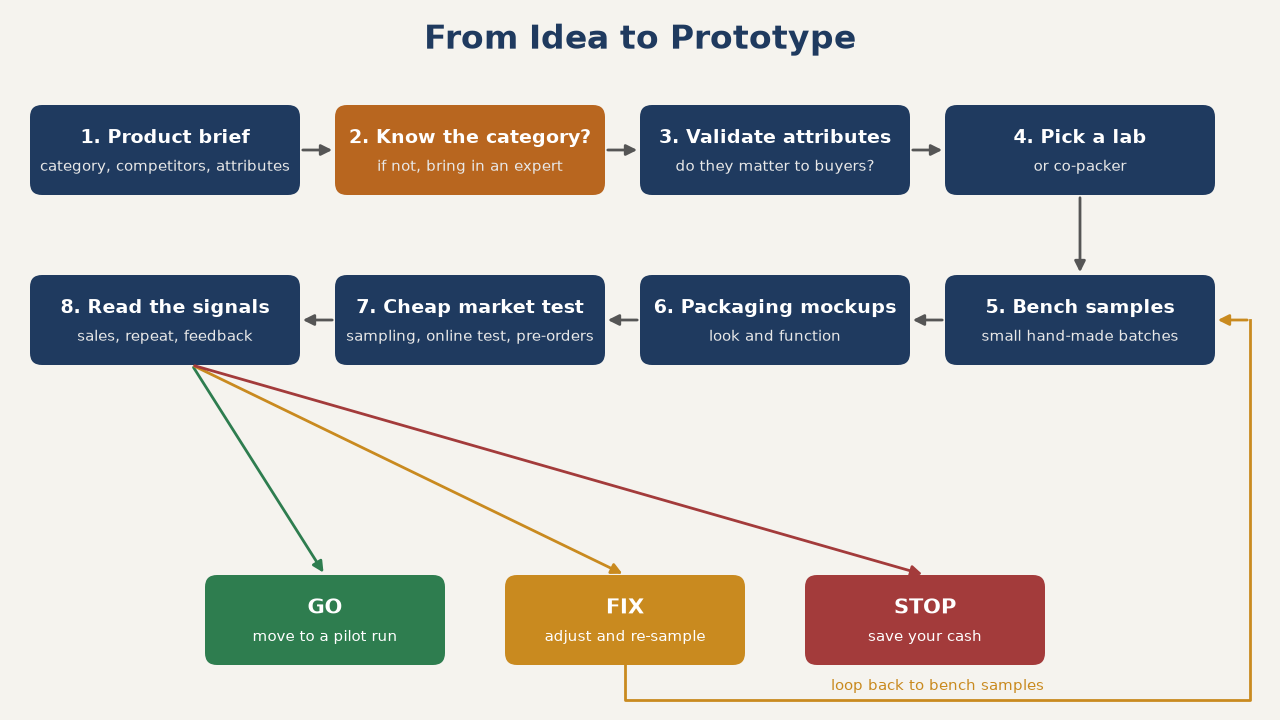
The short answer: Treat the prototype stage as a series of cheap experiments. Write a one page brief, check that your attributes matter to buyers, choose a lab or co-manufacturer, and use bench samples before a pilot run, so you have enough evidence to decide go, fix or stop before you spend real money.
Every product starts as an idea that sounds great in the kitchen. The hard part is turning it into something a stranger will pay for twice, made by someone else, at a cost that still works on a shelf.
At Vantage Business Consulting, we treat the prototype stage as a series of cheap experiments. The goal is not a perfect product. The goal is enough evidence to decide whether to spend real money on a pilot run.
Start With a One Page Product Brief
Before you call a single manufacturer, write down what you are making and for whom. A good brief fits on one page, in this order:
- Product category. Name the category you are entering.
- Current and adjacent competitors. List the products already doing this job, if they exist, and the closest neighbors if they do not.
- Desired attributes. What makes yours different: taste, scent, texture, format, claims such as organic or sugar free, or specific actives. Each attribute narrows your ingredient and supplier options.
- Target consumer. Who buys it, where they shop, and what they use today instead.
- Target cost. Work backward from the shelf price you want, as we lay out in our post on shelf price margin math. A product that tastes perfect but costs too much is not finished.
The brief keeps you and your manufacturer honest. Without it, every round of samples drifts.
The Important Question: Do I Know This Category?
Be honest here. Do you know how this category works: what it costs to make, which claims need testing or substantiation, what buyers expect, and where new brands usually stumble? And do you know an expert who can look at your brief, tell you whether the idea is viable, and point you to labs or co-packers who actually make this kind of product?
This is where Vantage Business Consulting comes in. We evaluate category viability against your brief and help identify labs and co-packers that fit your product, volume, and budget.
If the honest answer is no, let’s talk before you spend a dollar on samples. Grab 15 minutes with us →
Check That Your Attributes Matter to Buyers
Before you spend anything on formulation or samples, confirm that the attributes in your brief actually matter to your target consumer. Keep it simple and inexpensive:
- Short surveys. Five to ten questions sent to people who match your target consumer, not your friends. Ask them to rank attributes and say what they buy today.
- Interviews. A handful of 15 minute conversations with real buyers in the category.
- Competitor reviews. Read the reviews on competing products. Repeated complaints are openings.
- Social listening. Search forums, social posts, and comment threads in the category for what people wish existed.
If the attribute you planned to lead with barely registers, adjust the brief now. Changing a brief is far cheaper than changing a formula.
Pick a Lab or Co-Manufacturer
With the attributes validated, choose who will make your samples. An expert who knows the category can suggest labs and co-packers worth calling; that is part of what we do. You have three common paths:
- Formulation labs or product developers. Good for supplements, beverages, and fragrance where the formula is the product. You usually pay for development time and own the formula if the contract says so.
- Co-manufacturers with in house R&D. Convenient, but development may be tied to producing with them later. Read the terms.
- Independent food scientists or perfumers. Flexible and often faster for small brands, but you will still need a manufacturer who can scale the formula.
Ask every candidate the same questions: What are your minimums? Who owns the formula? What does a sample round cost and how long does it take? Can you source the ingredients I need at my volume? Have you made products like this before?
Bench Samples vs Pilot Runs
When the brief, the category check, the research, and the lab all line up, it is time to create bench samples.
Bench samples are small batches made by hand in a lab or kitchen. They prove the concept: taste, scent, texture, look. They are relatively inexpensive but do not prove the product can be made consistently at scale.
Pilot runs are small production runs on real equipment. They reveal what the bench hides: ingredient behavior at volume, fill accuracy, shelf stability, and true cost per unit. They cost meaningfully more and usually come with minimums for ingredients and packaging.
Do not skip from a bench sample you love straight to a full production order. The pilot run is where most surprises show up, and it is cheaper to find them there.
Minimums and Costs to Expect
We will not quote numbers here because they vary widely by category, region, and manufacturer. A candle and a canned energy drink do not share a cost structure, so get quotes for your category. What we can tell you is where the money goes:
- Development fees for formulation time and sample rounds.
- Ingredient minimums. Specialty ingredients often come in bulk sizes far larger than a first run needs.
- Production minimums set by the manufacturer, often driven by batch size or line time.
- Packaging minimums. Custom bottles, cans, jars, and printed cartons frequently carry the highest minimums of all.
- Testing. Shelf life, microbiological, potency, or safety testing depending on category.
Get written quotes for each line, then add them up against what you can realistically sell in the first few months.
Packaging Mockups Before Packaging Orders
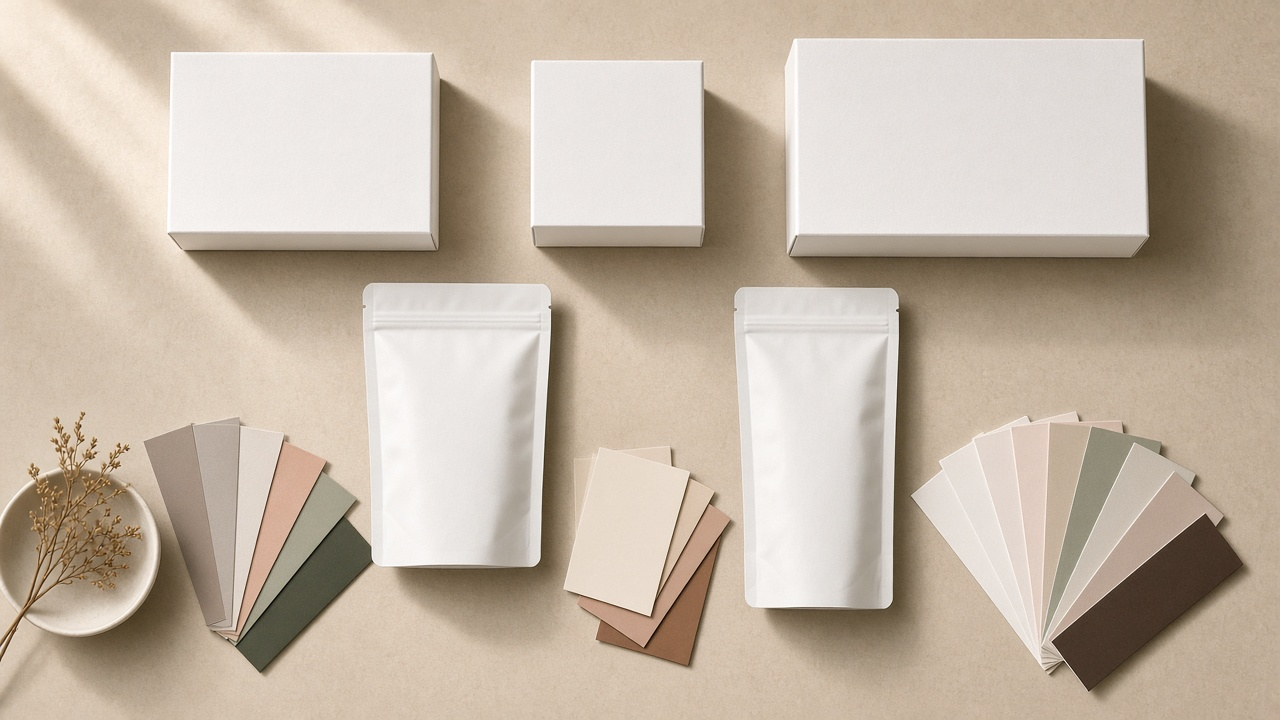
You do not need finished packaging to test. Use stock bottles, jars, or pouches with printed labels, or produce a small digital print run. Put the mockup on a real shelf next to competitors and take a photo from six feet away. If you cannot tell what it is or why it is different in two seconds, neither can a shopper.
Lock packaging only after the formula is stable.
Test the Market Cheaply

Friends and family are not a test. They love you and will not tell you the truth. You need strangers who have no reason to be polite.
Cheap ways to get real signal:
- A small online test. A simple landing page with paid social or search to a tightly defined audience. Measure clicks, sign ups, and pre-orders, not likes.
- Farmers markets and local shops. Watch who picks it up and who buys. Ask why in each case.
- Sampling events. Gyms, offices, studios, or community events that match your target consumer.
- Feedback surveys. Short, specific, and sent right after someone tries the product. Ask what they would pay and what they use today.
- Pre-orders. The strongest signal.
Go, Fix, or Stop
Decide your criteria before you see the results, so you are not tempted to explain away bad news.
Go when strangers buy without a discount, a meaningful share come back or ask when they can reorder, and your quoted cost still leaves healthy margin at your target shelf price. From there, the next questions are scale and route to market, including whether to bring on representation, which we cover in our post on choosing reps and brokers.
Fix when people like the idea but have a specific, repeated complaint: taste, scent throw, texture, price, or pack size. Fix the one thing and test again.
Stop when interest is polite but nobody pays, feedback is scattered with no common thread, or the cost cannot get anywhere near your target. Stopping here is far cheaper than stopping after a production run.
Protect the Formula
Sign a mutual NDA before you share your brief or formula with any lab, manufacturer, or consultant. Make sure your development agreement states clearly who owns the formula and any improvements. If a manufacturer will not put formula ownership in writing, treat that as information.
What to Do This Week
- Write your one page product brief: category, competitors, desired attributes, target consumer, and target cost.
- Answer honestly whether you know this category, and line up an expert if you do not.
- Run a quick attribute check: a short survey, three interviews, and an hour reading competitor reviews.
- Prepare a mutual NDA template before your first call.
- List three to five labs or co-manufacturers and send each the same questions.
- Write down your go, fix, and stop criteria now, before any samples or testing.
A prototype is not a product, and a product is not a business until the numbers work at scale, which is really a question of how big that first retail rollout should be. Get the evidence first, then spend.