The short answer: Under FIFRA, EPA treats a cleaning product as a pesticide if its labeling or sales materials claim it prevents, destroys, repels or mitigates a pest. Per EPA, claims like sanitizes, disinfects, or controls bacteria that cause odors trigger registration, while cleans stains or deodorizes generally do not. Websites, ads and testimonials count.
This is not legal advice. Pesticide rules are detailed and change over time. Confirm your specific claims with a regulatory consultant or counsel before you print or publish.
Most cleaning founders think about regulation in terms of ingredients. Under federal pesticide law, the words matter just as much. Two bottles with the same formula can be regulated differently because of what the label says.
The rule in one sentence
The U.S. Environmental Protection Agency explains this on its page Determining If a Cleaning Product Is a Pesticide Under FIFRA. Per EPA, FIFRA defines a pesticide as “any substance or mixture of substances intended for preventing, destroying, repelling, or mitigating any pest.” EPA says a product is intended for a pesticidal purpose if the seller “claims, states, or implies” that it does those things.
EPA also notes that cleaning agents and deodorizers are not pesticides “only if no pesticidal claim is made on their labeling or in connection with their sale and distribution.” In other words, the claim is the trigger.
What EPA says triggers registration
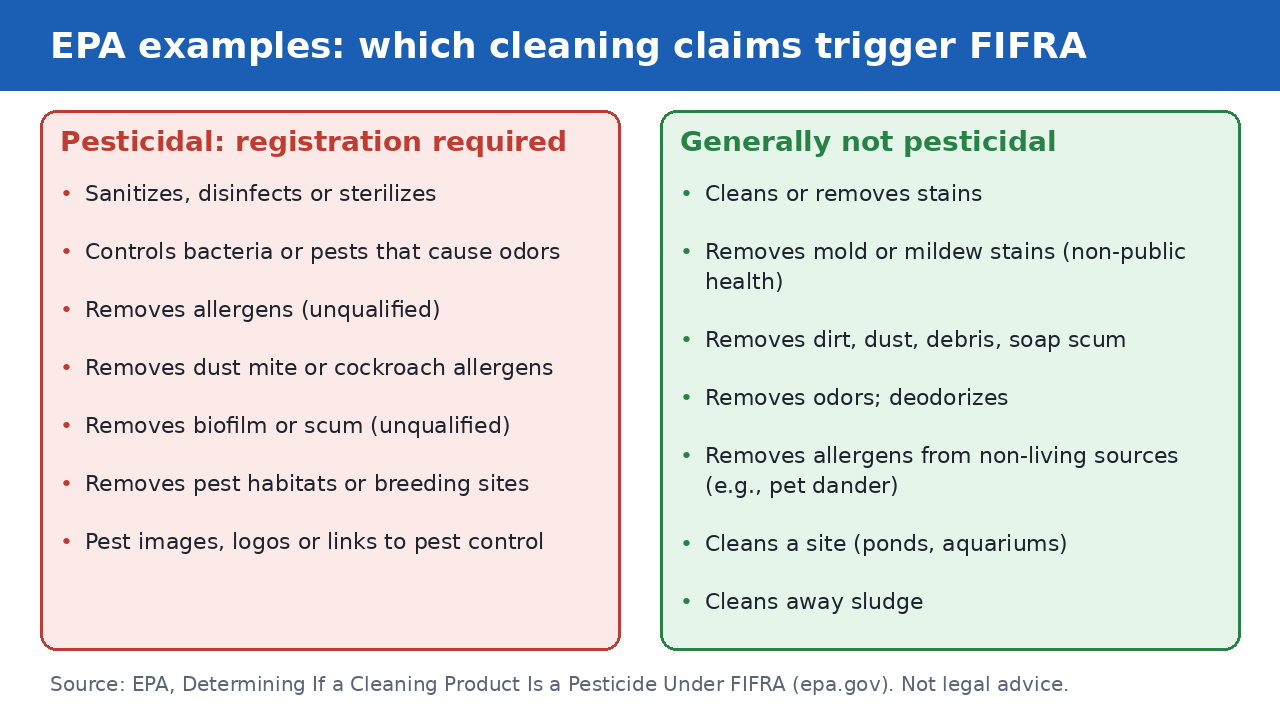
EPA lists examples it considers pesticidal. These are EPA’s examples, quoted or closely paraphrased from that page:
- “Sanitizes, disinfects or sterilizes.”
- “Prevents, blocks, removes, neutralizes or controls bacteria or other pests that cause odors.”
- “Cleans away, washes away or removes allergens (unqualified).”
- Removes allergens associated with a pest, such as dust mite or cockroach allergens.
- Removes biofilm or scum (unqualified).
- Cleans or removes pest habitats, breeding sites, or matter that feeds pests.
- Images of pests or pest habitats that imply removing them.
- Any banner, logo, or claim, including on websites and ads, that links the product to pest control.
EPA also lists claims it generally considers not pesticidal, when not paired with other pesticidal claims or context:
- “Cleans or removes stains.”
- Removes stains from algae, mold, mildew or other non-public health organisms.
- Removes dirt, soil, dust, debris, or inanimate scum such as soap scum.
- “Prevents, blocks, neutralizes, reduces, eliminates, encapsulates or removes odors; deodorizes.”
- Removes allergens from non-living sources, such as pet dander allergens or dust mite matter allergens.
Look at how close some pairs are. “Removes odors” is on the not pesticidal list. “Controls bacteria that cause odors” is on the pesticidal list. “Removes mold stains” is generally fine. One extra word is the difference.
EPA also describes a gray zone. Its example: a catalog or website that lists cleaning products right next to pesticidal products “could imply that the cleaning products are pesticidal,” depending on how it is arranged.
Your website, ads and testimonials count
This is the part founders miss. EPA states that its guidance applies to claims “on a cleaning product’s label or labeling or through other means such as web sites, advertising, promotional or sales activities and testimonial claims.” It adds that linking from your website to research showing pesticidal efficacy of an unregistered product “would be considered a pesticidal claim.”
So a clean label is not enough. Your product page, social posts, retailer listing copy, sell sheet, and the reviews you choose to feature all need the same discipline.
EPA also lists what can happen when an unregistered product makes pesticidal claims, including Notices of Warning, Stop Sale, Use, or Removal Orders, and civil penalties.
Claims strategy vs the cost of registering
This is a business decision, not just a compliance one. We frame it for clients as two paths.
Path one: stay a cleaner. Write claims around what the product removes: dirt, grease, stains, soap scum, odors. Audit every touchpoint for implied pest claims. This keeps you out of registration, keeps launch timing in your control, and avoids an extra layer of cost. The tradeoff is that you cannot make the germ claims some shoppers look for.
Path two: register. If a sanitizing or disinfecting claim is central to why shoppers buy, registration may be worth it. It means efficacy data, an EPA submission, review time, and fees, and many states require their own product registration too. We do not quote those costs here because they depend on the product and change over time; get current numbers from EPA and a regulatory consultant.
What we tell clients: decide the path before you design the label, write the website, or brief an influencer. Rewriting packaging after a buyer or regulator flags a claim costs more than getting it right first. Our post on going from idea to prototype covers where this decision fits in development.
A simple claims audit
- List every claim, on pack, online, in ads, and in retailer listings.
- Mark any word about germs, bacteria, viruses, mold as an organism, allergens, or pests.
- Check featured reviews and influencer copy for the same words.
- Check what sits next to your product on your own site.
- Take the marked list to a regulatory consultant or counsel.
- If you are unsure about a specific claim, EPA’s page invites producers to contact the Office of Pesticide Programs and request a written opinion.
Buyers notice this too. A claim problem found after authorization is a bad first impression, as we cover in what buyers want to see before they say yes. It also belongs on the list of GTM mistakes founders make.
Where we come in
Our founder started his career running small laundry brands at Dial, and has spent 34 years in consumer brands since. At Vantage Business Consulting, we help household and cleaning brands line up positioning, claims strategy, and retail plans so the label, the website, and the pitch tell the same story. We are not your regulatory counsel, but we can help you frame the decision and get to the right experts. If that would help, we would be glad to talk.
Messaging & Claims is one of the six areas in the Launch Readiness Scorecard. If you want to see where your launch stands on claims, positioning and the rest, take the free scorecard. It takes about 3 minutes.