The short answer: A distributor such as UNFI or KeHE warehouses and delivers your product, but it does not sell it to retailers. Orders come when a retail buyer authorizes your item and shoppers buy it. That pull comes from you or a broker pitching buyers, plus trade and marketing support that turns placements into reorders.
The email lands. You are approved. Your supplement, snack, or tea is now in the distributor’s catalog. Then a month goes by, and the order report is close to empty.
This is one of the most common surprises we see with natural, specialty food, and supplement brands. Nothing is broken. The yes just meant something different than it sounded.
A distributor is plumbing, not a sales force
A natural and specialty distributor buys your product, stores it, and delivers it to stores that already order from it. That is a logistics and credit service. It is valuable, and many retailers will not buy from a small brand without one. But it is not selling.
Others in the industry say the same thing plainly. The Big Box Broker calls UNFI and KeHE “gatekeepers, not salespeople” and warns that acceptance “does not put you on a single shelf.” CPG Founders Group puts it as order fulfillment: “You create the demand. They fulfill it.” Those are their words, and we agree with them.
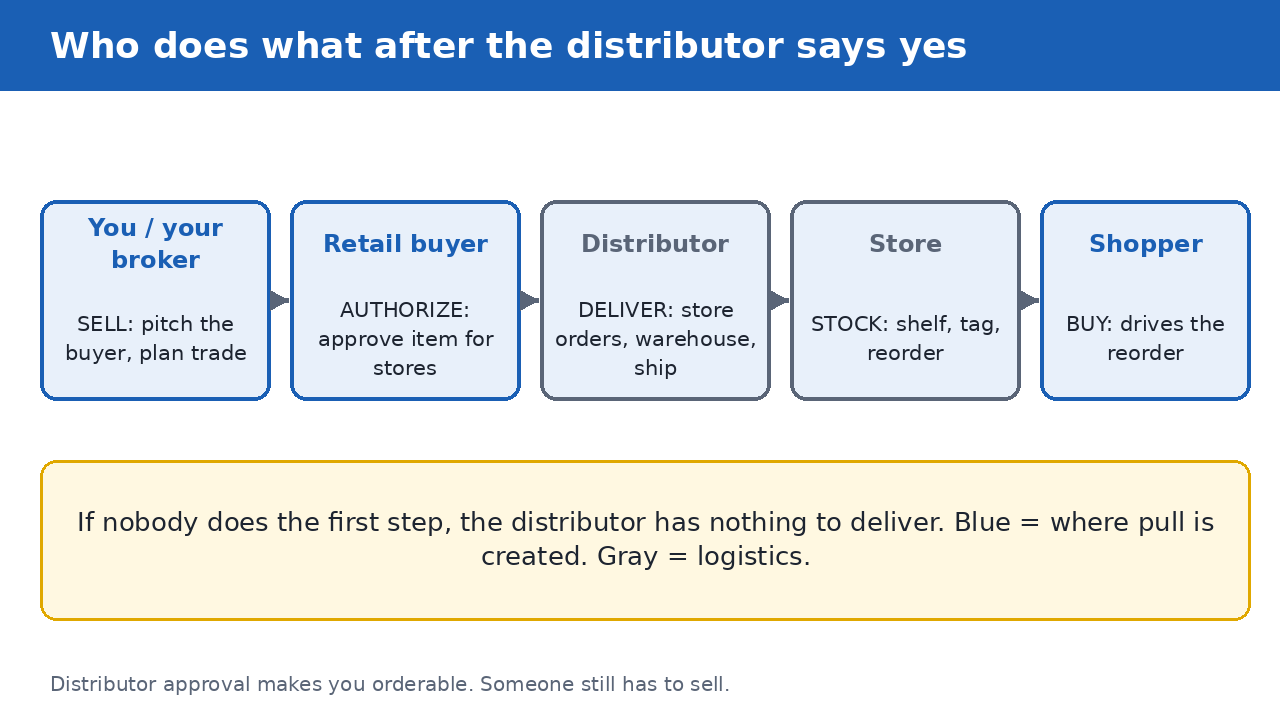
Here is the chain in plain terms:
- You or your broker pitch the retail buyer.
- The buyer authorizes the item for some or all stores.
- The distributor gets the store orders and ships them.
- The shopper decides whether the store reorders.
If nobody does step one, steps two through four never start.
What a distributor weighs before it says yes
A distributor decides to take on a brand based on a few things it can see:
- Retail demand. Are retailers asking for the item, or ready to authorize it?
- Velocity. Once it is on shelf, does it sell through, and how fast?
- Minimum order and guarantee policies. Distributors set terms on order minimums and on what the brand guarantees if product does not move. Those terms vary by distributor and by program, so ask for the current terms in writing rather than relying on what another brand was told.
The useful lesson is simple: distributors respond to retail demand. Walk in with buyer interest and a plan for sell-through, and the conversation changes.
Who creates pull
Pull has two halves.
Sell-in is getting buyers to authorize the item. That is selling: a sharp pitch, a margin story that works, a sell sheet, samples, and timing against the category review calendar.
Sell-through is getting shoppers to pick it up. That is demos, promotions, digital support, and making sure product is actually on the shelf. LemonLime’s supplement retail guide makes the same point from the buyer’s side: buyers “want a brand partner who will generate pull demand.” That is their framing; ours is simpler. If you do not plan for both halves, the distributor has nothing to deliver.
The broker’s role and how they get paid
A broker represents your brand to retail buyers. Good ones know the buyers, the review windows, and the paperwork each chain expects. They are paid on commission, usually a percentage of your invoice price. CPG Founders Group says natural channel brokers typically take about 5 percent. That matches the range we use for planning, roughly 3 to 5 percent, which we covered in our post on the math behind shelf price and margin. Typical planning ranges; confirm with each account.
A broker is not a substitute for demand. Our post on when the broker is doing your job covers what to expect from them and what stays on your desk.
What a broker really costs, as one P&L line
Founders look at 5 percent and think that is the cost. It is not. The broker gets you into accounts, and every account brings its own costs. We tell clients to put the whole deal on one line so they can see it:
- Broker commission on invoice
- Distributor margin and fees (The Big Box Broker cites a distribution margin that “commonly lands in the mid-teens to about 20 percent”, higher for some smaller accounts)
- Free fills or introductory discounts for new stores
- Promotional allowances and scan-downs the broker will recommend
- Samples, demos, and show costs
- Deductions and chargebacks
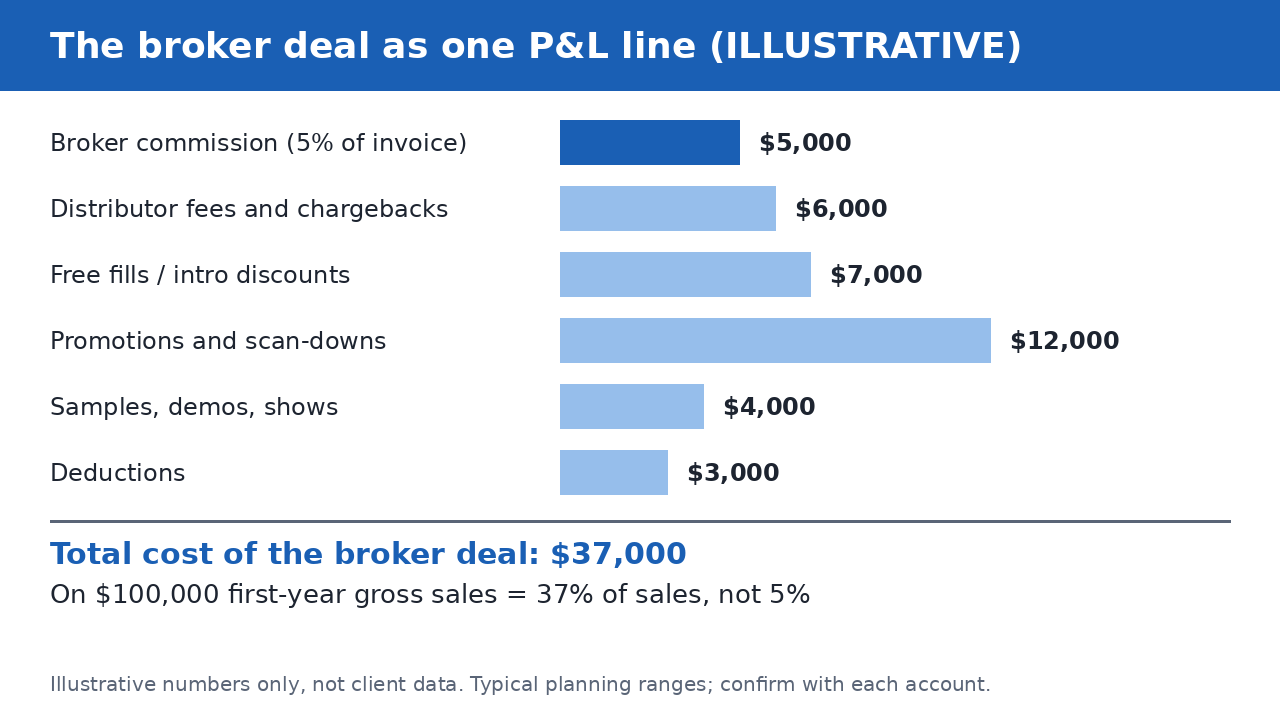
The chart uses illustrative numbers only, not client data. The point is the shape: commission is often the smallest piece. Add the lines, divide by expected first-year gross sales, and you have the real cost of the broker deal. If that number does not fit your margin, fix price, pack, or cost before you sign.
What a yes costs you
Approval also brings compliance rules, and missing them costs money. KeHE is a useful example because its rules are documented. Per SPS Commerce summaries of KeHE’s compliance program and KeHE’s Inbound Routing Guide (Version 16, July 1, 2026):
- EDI invoicing. KeHE charges $150 per invoice not received by EDI.
- Purchase order compliance. A 2% fee applies to non-compliant purchase orders.
- On-time shipping. Suppliers must keep an 85% on-time rate each calendar quarter, or each late shipment costs $250.
- Appointments. Truckloads need an appointment booked at least 7 days ahead through KeHE’s C3 system.
- PO acknowledgment. The 855 acknowledgment is due within 48 hours of the 850 purchase order.
These rules change. Work from the distributor’s current guide, not a summary, and build the EDI setup and the fee risk into your cost plan before the first PO arrives.
Before the yes
- Know which retailers you want and which distributor each one buys through.
- Have a buyer-ready sell sheet with wholesale price, suggested retail, case pack, and UPCs.
- Build the full waterfall so every margin gets paid. Our post on choosing reps and brokers walks through how to compare them.
- Budget launch trade and samples as a cash line, not a hope.
- Make sure you can fill the opening order plus one reorder.
After the yes
- Pitch buyers right away. The approval is your permission to sell, not the sale.
- Ask your broker for a named account list and a call cadence, in writing.
- Track authorized stores, stores actually ordering, and units per store per week.
- Watch your first 90 days closely. Buyers do, as we lay out in what buyers watch before the reorder.
- Check deductions on every remittance.
Where this leaves you
A distributor yes is a real milestone. It means your paperwork, pricing, and supply passed a gate. It is the start of selling, not the end of it.
Our founder has spent 34 years in consumer brands, from small laundry brands at Dial to co-founding Innovative Brands and Belae Brands. At Vantage Business Consulting we help founders line up the broker, the buyer plan, and the P&L before the distributor approval lands. If you are sitting on a yes with no orders, we would be glad to talk.
Next step: Before you chase a distributor, score yourself on the Channels area of our Launch Readiness Scorecard.